Pricing in the coffee market – how can it fluctuate so much?

From 12 €/kg to 22 €/kg on the grocery shelf in less than one year

I have clients requesting why raw coffee is so expensive compared to four years ago, when people were at home and drank coffee all the time. Looking at the grocery shelf I could see the same coffee climbing from 14 € per kilogram to 22 € and then going back to 12 €/Kilogram for a special offer.

To answer my clients, I had to look past the grocery shelf and into the exchanges where prices are determined by the ‘Logistics of Time’—speculative contracts that bet on stories like climate change rather than the stable harvest cycle shown in my graph.

The prices for coffee beans – standard arabica – are quite volatile and not always justified. The prices are determined on exchange and it is possible to buy and sell contracts for future coffee and for difference in prices (CTDs). CTDS are not listed in the number of sold bags. Bags are a standard unit for coffee and about 60 kg. On its way from raw coffee to the grocery shelf the coffee goes through a roastery and looses about 20% of its weight. That tells that a seller needs at least 2-2,5 times the raw coffee price at the shelf to cover roasting, taxes, packaging, transporting and selling costs.

YearApprox. Price (€/kg)Forensic Context
2011€4.25Peak volatility; high logistics and supply chain friction.
2013€2.32Prices reaching a bottom level.
2018€2.50Strong supply surplus (the “186-million-bag” pressure).
2021€3.82Post-pandemic logistics “Noise” and supply chain shifts.
2024€4.80+Current volatility requiring Resilient Pricing to protect margins.
2025€ 7.55Stabilizing on high levels, futures are getting slowly cheaper

I have a graph which includes harvested coffee beans and prices:

On the right side there is the price, which reached more than 8 € per Kilogram, and on the left side and in the light blue bars there is the amount harvested in the year, epressed in bags per month. The price for coffee fluctuated much more than the amount of harvested beans.

Would climate change make coffee more expensive or disappear

On January 24th 2024 the Economist, one of the leading journals for political economy wrote:

“But global warming threatens the world’s coffee supply. Temperatures are rising and rainfall patterns shifting across South America, central Africa and South-East Asia, where most of the world’s coffee is grown. By the end of the century between 35% and 75% of the coffee-growing land in Brazil, the world’s biggest producer, could be unusable, according to a recent paper published in Science of the Total Environment by Cássia Gabriele Dias, an agricultural engineer at the Federal University of Itajubá, in Brazil.”

The reports in many other journals and newspapers pointed in the same direction. Coffee drinkers are expected to stay with coffee and paying higher prices for a scarce good, not moving to beer, wine or tea.

How to make money with betting on raising or falling prices

To provide a Fact-Based Foundation for your coffee article, we can Reverse Engineer a classic futures trade. In the coffee market, speculation isn’t about the physical beans in a sack; it’s about the “Logistics of Time.”

Here is a comprehensible example of Short Selling—the strategy used when a speculator believes the price is currently anchored too high and will drop.


About Climate Change: I know that climate change is real. The only thing to discuss is how fast we will notice and what to do to live with it.

The Scenario: The “Climate Change fast” Hallucination

  • Physical Reality: It is July in Brazil. A rumor of a “Climate Change fast” hits the market.
  • The Reaction: Prices spike to $2.50/lb because of fear (Noise).
  • Your Analysis: You look at the weather data and see the “Climate Change fast” didn’t actually hit the main growing regions. You realize the $2.50 price is a “Data Hallucination.”

The Move: Short Selling (Selling what you don’t own)

  1. The Contract: You “sell” 1 contract (37,500 lbs of Arabica) at the current high price of $2.50/lb.
    • Total Value: $93,750
  2. The Wait: Two weeks later, the market realizes the “Climate Change fast” was a false alarm. The price drops back to the $2.00/lb equilibrium.
  3. The Cover: You “buy back” the contract at $2.00/lb to close your position.
    • Cost to buy back: $75,000
  4. The “Bacon” (Profit): The difference stays in your pocket.
    • $18,750 Profit (minus transaction fees).

Most coffee is traded by direct contract, sometimes long-term, between buyer and seller. Many contracts have the exchange price as anchor.

Here is a graph of the coffee traded and the prices for 2024 and 2025:

The Verdict: Speculation is just a bet on which “Story” will come true.

The following graph shows the amount of traded coffee and prices. While prices went up on a regular base, there was much more coffee traded than today – in the first chapter we saw that the real harvest was only about 5% less than in the years before and is expected to grow about 8% compared to 2018.

How prices stayed high after the end of speculation

The graph shows that at the time the coffee prices reached a certain level speculative demand collapsed. It was too dangerous for speculants.

Coffee prices and Amount of traded coffee

Value Sensivity Check – Giving Price Elasticity a New Meaning for Consultants, Freelancers and Coaches

The Value Sensivity Check is a systematic instrument to avoid encourages simply raising prices and instead focuses on the value of the service for the customers. A high rate without a clear foundation invites client skepticism, which can ultimately lead to disappointment and strain the relationship.

The true strategic question moves beyond ‘how high can we charge?’ to ‘how can we structure our pricing so clearly and demonstrably that clients fully trust the value of our premium?’

From Generic Pricing Trap to Appropriate Value

The primary challenge in pricing specialized consulting services often stems from a structural misalignment of incentives.

The Core Issue: Inherited Cost Models

Many consultants and specialized professionals, drawing from the traditions of skilled trades and technical service, default to calculating fees based on hourly rates plus a cost surcharge. While this method is transparent, it inherently measures effort rather than value. Also these hourly rates are debatable: they are not specific for market segments.

This design leaves little room to reward the consultant for efficiency or accelerated knowledge transfer, inadvertently placing the focus on hours delivered rather than rapid client outcome.

This time-based model, though conventional, creates an inherent conflict: the client seeks speed and productivity, while the fee structure measures time spent. This misalignment subtly erodes the commercial confidence required for a true, value-driven partnership.”

Specialized consultants often find themselves facing a pricing vacuum, where generalized market advice offers no rigorous, evidence-based answer to their inherent value. My goal is to replace this reliance on subjective guesswork with a structured process that instills true commercial confidence.

The Value Sensitivity Check (VSC) for Price Elasticity serves as the necessary bridge to solve this structural uncertainty.

Grounded in fundamental price elasticity considerations, the VSC offers a secure framework designed to ensure the price achieves a perfect balance: fostering client trust, covering the supplier’s costs, and reflecting genuine value for the buyer.

The VSC™ is the systematic framework that closes the gap between traditional cost calculation and sophisticated value estimation. It guides the professional in building a fully justifiable price structure supported by unassailable evidence.

The Two-Tiered Justification: Reconciling Value with Trust

The greatest hurdle in securing a premium price is the client’s internal alginment process. They must arrange the large, abstract claim of high market value with their personal and experience-based need to trust the seller. I manage this by providing justification at two distinct levels:

1. The Macro-Justification (Economic Proof)

This addresses the logical, objective claim. It involves benchmarking against public economic data, market failure rates, and the true cost of alternatives to prove that the investment in the product or sevices is necessary and proportional to the risk being mitigated or eliminated.

2. The Micro-Validation (Personal Trust)

This addresses the psychological, subjective claim. It is built through small, unexpected details within the process, demonstrating authenticity, competence, and a specialized understanding of the client’s specific world.

These personalized “Micro-Signals” are the necessary evidence that the consultant possesses the process and specialized expertise to manage the client’s commercial risk. The systematic, structured nature of the Value Sensitivity Check (VSC)—available via questionnaire in English, German, and French—is designed to integrate both the Macro-Justification and the Micro-Validation seamlessly into your client communication. My answers and evaluations are provided in the language you prefer.

Willingness to Pay

there might be need to first know it, then re-anchor it and so to avoid leaving money on the table.

When we think about ordering a service and have some information about offers and a clear picture what we want, we have a Latitude of Acceptance of prices in mind. WTP is Willingness to pay for a service or product, and we may need to re-anchor the frame.

Price confidence is not about believing in your value; it’s about having the data to prove the client’s risk is greater than your fee.

Re-Anchor Your Client's WTP to Avoid Leaving Money on the Table -use the Assimilation-Contrast Theory

The Problem: Weak Anchors

As we discussed, most clients default to weak, external anchors:

  • Competitor Prices (External Anchor): Easy to find, but instantly anchors the WTP low, leading to sub-optimal pricing.
  • Trade Association Guidelines (External Anchor): Provides safety, but ignores the consultant’s unique value and capacity.
  • What the client paid for similar projects before (Internal Anchor)

These weak anchors by clients result in an unknown Willingness-to-Buy (WTB) and fear of the Pricing Whiplash on the suppliers side – a wild haggling with prices without foundation. This is if an originally called price is too high or too low, and the seller needs to recalibrate his prices without changing the offer fast. This is the fastest way to loose clients trust.

The Cost of Not Buying, Anchoring It and Sharing It

We may focus on the Cost-of-not buying. When we have this, we have the strongest argument we can get. The latitude of acceptance for the client is drawn by the clients’share of the CoNB. Fortunately identifying the CoNB is not rocket science. I do not want to go into details there because it differs between for example lawyers, hairdressers, graphic designers, coaches and real estate agents.

More Success in Price Negotiations With Decision Tree

Going into price negotiations without a lot of preliminary information mostly ends up in suboptimal results. This post is about structuring in the information in a decision tree stuffed with probabilities for the events. These probabilities are the result of market research.

The party with the most information has advantages in negotiations. They know the negotiation scope of the other side and th bargaining power do both sides. Other questios are: What do I want? How to avoid getting lost in bargaining? After looking into auctions, where for psychological reasons it is difficult to make rational decisions, I look at the decision tree with estimated earnings and probabilities.

Auctions – the risc of following the group

Auctions are popular for antiques, used items and real estate. In the bidding war the offers may run away while the auctionator counts highet and higher. This war requires at least two bidders. Participants see and hear competitors bid higher and higher and infect one another. The bidding continues, so the race goes on for not having a defeat. Giving up means the object is gone. Due to the short decision-making period and the group, spontaneous decisions are made, which be confirmed experimentally. As soon as the bid is accepted, the bidder goes back to his rational normal and recalculates: the high purchase price makes the investment unprofitable. The buyer tries to get out of the contract. This phenomenon occurs less often if a security deposit to be presented limits the bids.

How a decision tree helps

We try to look at every possible scenario and calculate the probability of that scenario. The example is about a freelance teacher, who applies for teaching a class. How much money will she get?
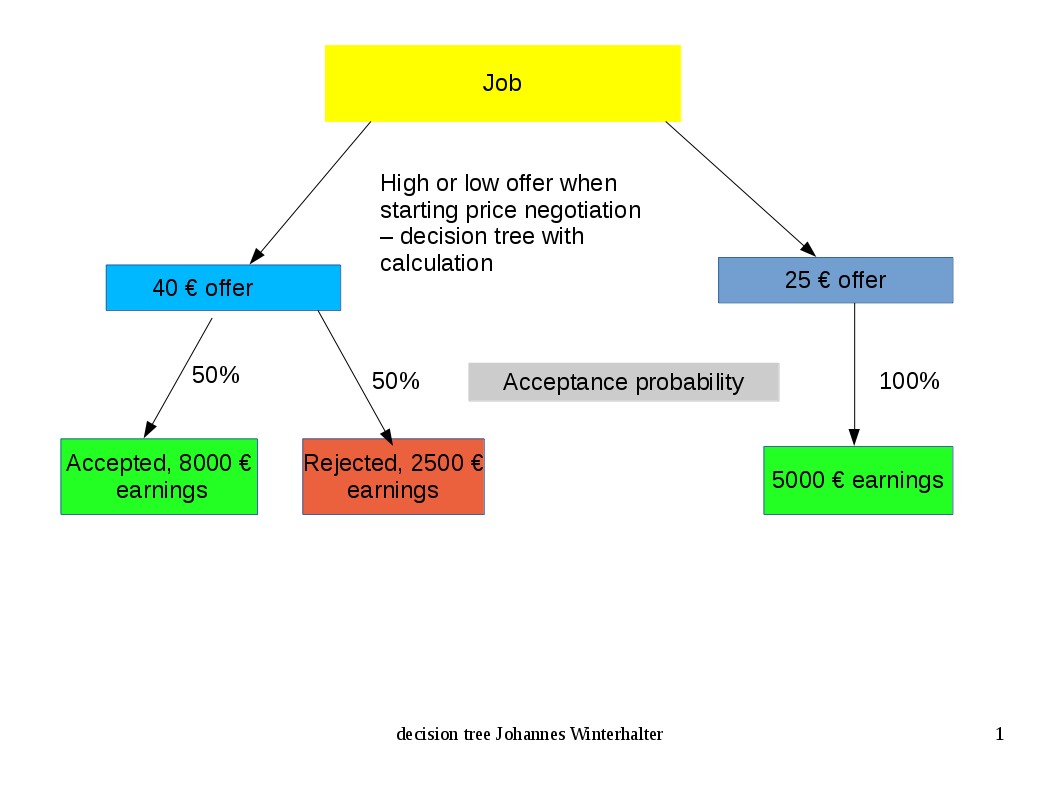
decision tree usable for price negotiation – probabiliy and earnings

Sandra is applying to be a lecturer at the Montgomery Training Center. She has no experience and is pretty much broke right now, so she urgently needs paid work, her lower limit is 20 euros an hour. But she wants to achieve the maximum possible hourly rate in order to look good in front of her friends and colleagues and to earn money.

Sandra negotiantes with the dean, Ms. Dr. Teufel. She wants more earnings for the school and save money spent on teacher salaries. If teachers are scarce or one has special qualifications, she can pay up to 40 euros per hour. She tells the applicants that there are lecturers who work almost on a voluntary basis. So it tests their price scope downwards. That the training center also hires expensive lecturers is not for the appliants ears.

Doing background research helps

Sandra asks herself how much she could ask. She estimates that the school can spend up to 50% of the participiants fees for lecturers salaries[2] . The difficult question about the income of the training center can be answered with the help of price lists of the company, sales figures from the Federal Gazette (corporations have to publish there), inquired or estimated numbers of participants. Sandra does the math and comes to a maximum of 40 € per hour.

Sandra analyzes her competition. What is the likelihood that another qualified person will do it cheaper? This is very high when teaching in university cities. Public statistics on wage levels can help, or a survey among friends. Industry associations often have fee statistics. She heard from friends that they often only pay 25 euros per lesson. So what to do in the price negotiations?

Price Negotiations and Background Research: Add Probabilities to the decision tree and play with scenarios

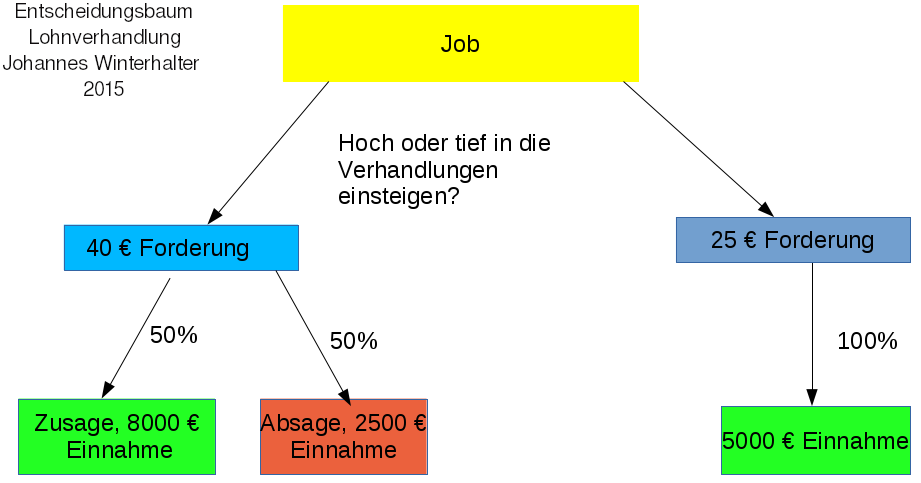
The probability that a sufficiently qualified applicant appears charging only charges 25 euros per hour is 50%. Let’s figure out whether Sandra should play it safe and demand 25 euros per hour or whether it is worth asking 40 euros per hour. The contract lasts for 200 hours, i.e. 5000 euros at 25 euros per hour and 8000 euros at 40 euros per hour.

Sandra realizes that she still doesn’t know enough about the lecturer market. What is the probability that in the case of a rejection by Dr. Teufel, a new job of the same type appears that brings in at least € 40 an hour? It is not possible to ask the competition, they will hardly tell the truth. Miss Dr. The devil is also talking about volunteering, so no wages at all.

Looking at the decision tree: if demanding 25 € per hour Sandra has the job safe and gets 5000 Euros. Demanding 40 € there is a 50% chance that she will earn 8000 Euro and 50% that she needs to go cleaning houses for 12,50 Euro each hour, that makes 2500 €. In addition and weighted by probability this goes to 5250 €, slightly more than talking about the low price.

External Factors – Prestige and Feeling Safe

Sandra possibly thinks she definitely needs the teaching job. She no longer wants to clean and needs references. Then she plays safe and only charges 25 € per hour. Demanding high prices is only worthwhile to a limited extent, as the previous analysis shows. The opportunity costs in the form of stressed nerves can be an argument for low claims.[3]
————————————————————–

  1. [2] To know this average value, information about the business model of the schools is necessary. The basis is the commercial calculation with cost price, handling costs – and profit surcharge and sales price. The lecturer’s fee is the cost price, the remuneration paid by the participants per lesson is the sales price. The trading surcharge includes rooms, advertising, administration and risk. [3]
  2. [3] Between 2008 to 2010 I did some tests with groups of 30 participants about that subject. The results were that very young people tend to ask too little money, older people tend to ask too much in price negotiations for work.
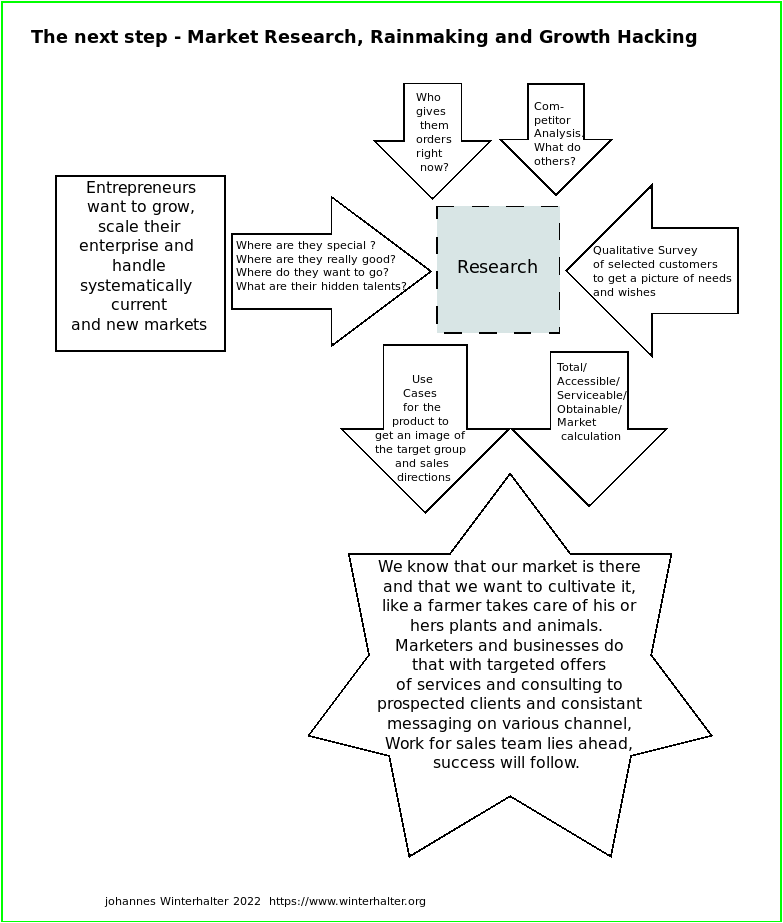
Targeting Marketing With Qualitative Market Research

Why we need a buyers persona

A buyers persona is a picture of our targeted group. It says persona for the reason we do not need to know everything about that person and there might be different persons in our target group. The second part is about qualitative market research. We use this kind of searching for behavioural characteristics for creating this buyers persona.

A wrong image of our target group costs us money and makes our brand less popular. Simple example is posting on Linkedin without reducing the number of followers. I looked at the list of people I unfollowed. The reason for doing that was that they posted repeatedly content I do not like or is just not true. Most of them are aging german business trainers spreading far-right political statements and sometimes even far-right lies. The other ones are sales newbies who spread too often their pitches aimed at a different buyer persona than me. Is a close group of followers who believe the same political statements as the poster the thing the poster wanted? If there is no reaction to your post does hammering out repeatedly the same sales pitches again and again to the wrong targets a good thing? Or should we appeal to a broader audience?

Why qualitative Market Research

This article is about bringing qualitive and quantitave research together with integrating numbers and representativity into qualitative research. Quantitative research is primarely counting and statistics.

To research people ‘qualitatively’ means that you intend to understand them. This is beyond algorithms. Let me show you how best to do this. I am here to listen to you. (Elif Kus Saillard)

The topic of qualitative market research is understanding. What does the world of my target group look like? What emotional and financial settings do they have? Quantitative research, on the other hand, determines how many people in the target group have which attitudes, how many they are and how their budget looks. A random sample is drawn so that not all members have to be questioned.

The claim of qualitative market research

Qualitative market researchers understand the customers. Its like some newspapers articles, where journalists describe some individuals where they think they are good for the numbers. Quantitave shows the numbers – for example 60% believe that the government does a good job in education. Discussions in focus groups, in-depth interviews, images, social media and much more can be used as data sources for qualitative research.

Correct information with automated product recommendations
What will be the result of qualitative market research into her wishes?

Also compare here (New Market Research Blog). The qualitative market researcher is an active part of the research process. He or she uses their subjectivity to better understand the phenomenon being studied. You want to understand why people believe in what and see the world a certain way. A qualitative researcher wants to understand the process of selecting a product, for example. A quantitative researcher wants numbers, averages, and more. Manufacturers and dealers can then base their decisions on this.

How qualitative researchers can do representative studies with small numbers

A qualitative researcher makes small samples. Understanding the process and the mindset of the subjects, this researcher assumes some validity. To ensure this this procedure can help:

The result of the small sample are suitable when no changes are to be expected from a larger sample. This can be checked by first evaluating 30 questionnaires. Hopefully there is no significant change with a further 10 questionnaires. If there is, another 10 questionnaires are added. If this does not maintain the hypothesis that the differences in responses are statistically insignificant, the study can be considered representative provided the responding participants represent the target group.

Some subjects suitable for qualitative studies:

  1. Lists of ideas – if the ideas are repeated, the study can be ended. Studies that do not record the subjects’ ideas via structured questions but via free text information fall into this category.
  2. All – or – none results. If every participant in a small study says the same thing—like, “I see a train station in this ad,” or “I prefer the new packaging”—the conclusions are likely to be valid, even with small samples.
  3. Strong hypotheses for the study to support If we have a hunch and it is supported by the small sample, we can be sure that the hunch is correct. All we have to do is verify that the underlying hypothesis is not just speculation. This type of market research is popular with journalists who can get by with just a few interviews.
  4. Understanding instead of measuring – for example customer journey. This analysis helps testing new products.

The problem of representativeness in qualitative research remains.

With small samples, the problem of representativeness remains. There is no statistical way to ensure the representativeness of a non-probable sample. The market researcher’s judgment must be added here: can the result be as the study suggests or are there other, contradictory results? Trusting only statistically proven results without knowing the underlying connections can be misleading.

How prices are perceived from seller and buyer

Pricing affects everybody. Selling your apartment, selling used furniture, doing salary negotiations or finding prices for your products. How to find a price liked by the seller and buyer? In my seller history I found situations with low prices where the customer voluntarely added a gift, and many situations where nobody wanted to buy. The reason for this can be “no market for the product” and “price is prohibitively high”. The latter one means there is a market for the product, but not at the charged price.

The next chapters give structure to this complicated matter.

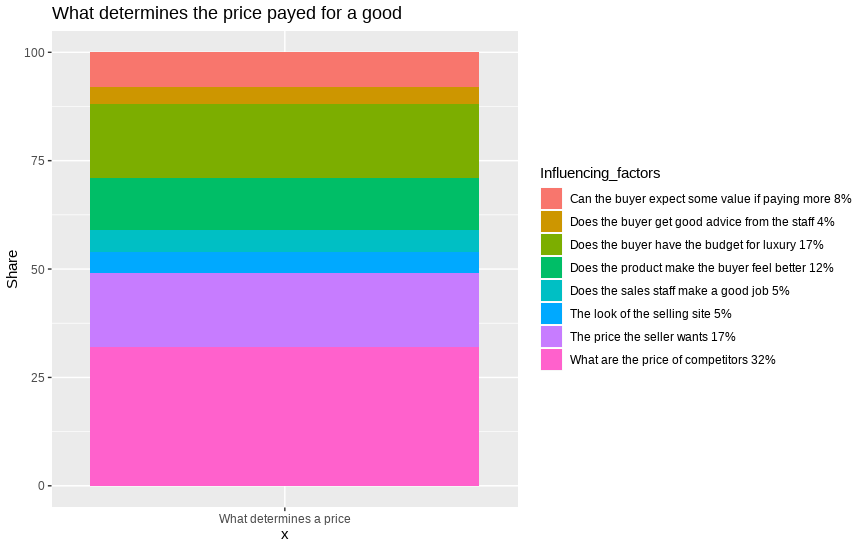
The classical theory of pricing for optimal is very simplified. It assumes a linear demand function, with only one determinant, the price: demand=f(price) . This means only demand determines the price. What happens if demand has many more determinants?

This can be:

  1. The look of the selling (web-)site
  2. Do the salesmen make a good job?
  3. Do I get good advice from the staff?
  4. Can I expect some value if I pay more?
  5. Does the product make me feel better?
  6. Do I have the budget for luxury?
  7. What are the prices of the competitors?
  8. The price the seller wants

Point 1-4 are the value to the product added by a good sales team. Example: if a retail store buys a pallet with 1000 packets pasta for 600 € and sells the package for 1,2 € the sold package is not the same product as on the pallet. The services of the retail store are added.

The following graph is an example. It may look different for a specific produkt. The graph with the numbers given there works good for used cars and expensive utilities sold on Ebay or webshops. Later in this posting I discuss the concept of a buyers persona for looking at different perceptions and factors which influence willingnes to pay.

What Expectations and Experiences determine the market price of a good
What Expectations and Experiences determine the market price of a good – example with estimated numbers for factors influencing the market price in the case of price differentiation (customers pay different prices).

Example: make advice a valuable good

Many brick-and-mortar retailers complain that their customers do not pay for advice. What they do not tell: how much do their prices differ from common internet sellers without any consultancy? Is there really value added in the store?

In old times, when sales was based on printed catalogs, there was the famous trade costing, with list prices, heavy rebates, and purchase prices. Most retailers ordered their stuff at wholesales, which themselves made their cuts. The result was that end user prices were about 3-10 times as high as the factory price. I understand that many want this time back. The customers had no choice, they had to buy locally. Many wishes and dreams of customers weren’t ever fulfilled for the high costs of maintaining catalogs and storage.

Now many internet retailers order directly at the manufacturers, and they have to look for competing offers worldwide.

Customer or Buyer Persona and Pricing

Customers view the product and selling environment different regarding their personal lifestyle, income and values. Depending on the product I normally look at two up to four buyers personas with different characteristics, where I draw a line between them with the help of characteristics I found with market research.

Selling Services

There are two approaches for long-term pricing: with interchangeable goods, many manufacturers, in the long run the price will be the production cost plus some earnings. The earnings are the incentive for producing. Examble: a spare part for an historic car. Production cost is 150 €, with this part added the car gains 2000 € value. If the seller knows that and wants a high price, the buyer might look for another source which produces it for 150 € and pays additional 50 € for the favor.

In Services it is a bit different. Production costs is one side. The other is: how much will the buyer profit from my service? If the seller, you, knows that 25-50% of the profit for the seller, the trainer or consultant, are normal.

Is there a formula for prices?

In economic theory the price is equal to marginal use. That means the price equals the benefit the buyer thinks he has from the last unit he or she buys.

If we can measure the benefit in money and realtime, we have the formula.

The benefits are listed at the beginning of the article. The problem is that the customer does so many estimations, that change over time. Also new competitors with low price entrance strategy might show up.

When selling over a website it is quite easy. Look at the ones who buy related to the ones who look at the article. If there are many who look and do not buy then lower the price, if most of the visitors buy then raise. This needs a lot of finetuning. Sometimes visitors look a few times at the articles until they finally buy. When they see that the prices go down, they might wait even longer. So you might want to include the total number of visitors.

How to calculate?

There is a mathematical formula and there are ways to survey it.

We measure the first eight determinants, with due consideration of costs:

determinanthow to find and count
The look of the sales (website) position.Survey of visitors
Are the salespeople doing a good job?not available everywhere, get feedback
Do I get good advice from the staff?Get feedback
Can I expect value if I pay more?Tests and surveys on buying motivation, own samples
Do I feel better because of the product?Tests and surveys on buying motivation
Do I have the budget for luxury?Experiments, interviews
What are the prices of the competitors?Research
The price the seller wantsLook deep inside you

Market research helps with the first six points. Usually it is necessary to repeat the market research every 3-6 months with the well-known market research problem: the target person doesn’t like to answer. They are bored and do not know whatfor they took their time to answer the questions. We must therefore look for other methods. An easy-to-install method is to encourage visitors to comment. You may get 1-5% comments from the customers. This responses add up to valuable data source. It is also possible to conduct studies with paid testers. There are some problems with representation of the correct user group there, additional research helps to circumvent this.

Photo du titre by Egor Myznik on Unsplash

Storytelling makes successfull

How do I find the right story for my product, how does my storytelling become a success?

Products are enhanced with storytelling. I am looking for a 17 mm socket, which of the three available nuts or wrench sockets will I buy:

  1. Simple picture on blue background, price € 5.60, supplier unknown
  2. Same picture as 1., but additional information that it was made in China by a small factory in Shenzen from the best steel for heavy use, price 8.30 €
  3. Again the same picture as 1., and the same manufacturer as 2. The dealer introduces himself as Franz Müller from Rottweil in deep Swabia, who specializes in the sale of quality tools. Price € 9.20.

I learned that Swabian dealers are very quality conscious. Franz Müller connects to my experience, and his story gives me expectation that the tool will run smoothly and that can use it without any problems. I order his stuff despite the higher price.

Storytelling has to appeal the customer’s mental world

Good examples for that:

  1. Promise of getting rich fast with Network Marketing. You are shown the beauty of wealth. The way to do this is very simple: you win a few customers who in turn win new customers.
  2. Anyone who has ever been to partner exchanges surely knows the many supposedly young and good-looking women and men who promise the perfect relationship. Fortunately, they don’t present their price list until late, so you don’t have to pay for the illusion of a perfect relationship due to the lack of a valid contract.
  3. Berlin advertising agencies in particular currently love telling stories from the ideal world of the rurals village or a small city with intact neighborhood “where everybody knows your name. The stories are pinned to every product whose distributor requests it.
  4. Coaches encourage other their coaching clients to tell their history. That is supposed to induce more interest from potential customers. A very common story is that of the poor lady or gentleman, stricken by fate. This person believed him/herself and made it again into great wealth. And there are photos from trips to exotic places or they buy artworks.

How to find your story?

Take care that your story does not disguise the product, unless the story is the product. Example: an email from a coach who promised me a great development as a globally admired speaker and expert in my discipline. I asked myself: “What does he even offer”? It was simply an rhetoric training, as I learned later. By reaching into the rhetorical multi-level marketing language, however, he created unpleasant associations for me. If any kind attention was the target of the action, the coach is successful. If he wants to be a serious personnel developer, less so.

Market Research helps you to find about more about your targeted group.

To the featured image: Thanks to Allie for sharing their work on Unsplash.Photo by Allie on Unsplash

Why we use Bitcoin for creating wealth, not for daily payments

Bitcoin is a freely tradable cryptocurrency. A currency needs security against unauthorized copying. With normal money this is done by the central bank and the state, with bitcoins with strong encryption and a publicly accessible database with 262 gigabytes of data in May 2020.

There is a maximum of 21 million Bitcoin to be scraped. Currently there are 18.4 million. A limited amount of a good gives hope for an increase in value. That is the matter with gold, in some areas with housing. The prospect of increased value makes people to invest in goods who bear no interest. In the following, I analyze whether buying and selling Bitcoin might bring a good return.

Bitcoin lures with impressive price fluctuations, longer periods of steadily rising prices and, unfortunately, a few crashes.

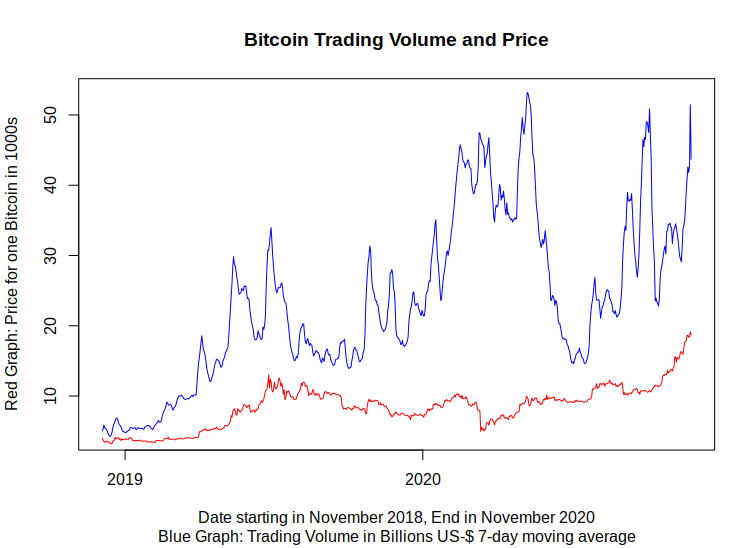
The lowest price for a complete Bitcoin in the period covered by the graph was 3207 US-$ on 2018-12-14. Successful traders bought for example for that price and sold high for 19107,46 US-$ on 2020-11-24. Which good makes six times its value in two years?

In the years after I wrote this article the bitcoin reached 40.000 US-$-

I used the close prices of the days. Bitcoin prices are changing fast along the day. About 15% of all existing bitcoins are sold on one day. Also high prices slower the market: it is visible and statistcally noticeable that high prices lower the trading volume. That is not only in cryptocurrency market. Real Estate also knows this phenomena.

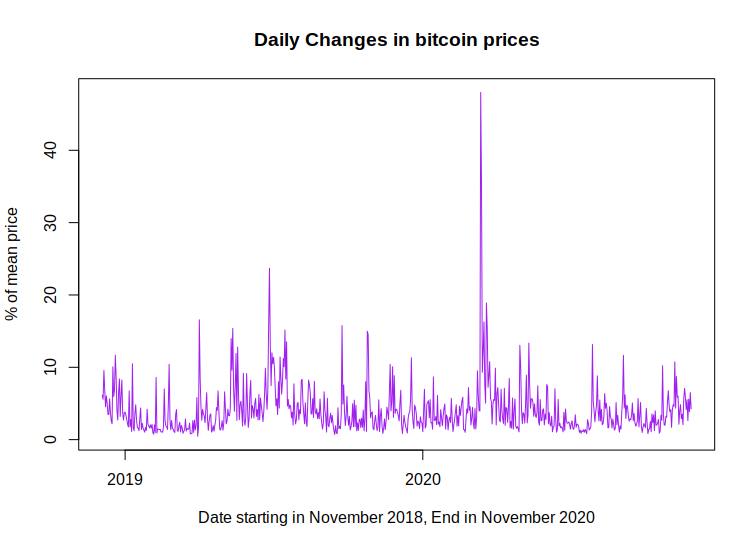
The picture shows that during the normal day the prices fluctuate by 5-10%. Only on explosive days, less than 11 days out of 723, did prices fluctuate more than 15%. Considering usual transaction fees of 0.1-5%, you can win and lose very quickly. Current sales offers and trading conditions can be found e.g. here.

Bitcoins are very speculative. The reason for the many offers for investing in Bitcoin is that if somebody owns already the currency convincing others to buy it also raises the prices. Now it is possible to sell the the own stock and make a little fortune.

Using Bitcoin for payments

Bitcoin als Zahlungsmittel
Bitcoin for payments

for legal transactions:

The fees for exchanging cryptocurrency into stone age currency such as Euros or US dollars are 3-5% of the value, as is the case for transferring an amount of money to another account. The reason is the high computing power required for the encrypted currency. PayPal takes 1-2.5% of the transferred amount for the same service, the banks go down to 0.1%. The advantage of Bitcoin is the secure transmission: are the bitcoins stored in your wallet they are yours. There is no chance for the delvering side to get it back, like for example in European direct debit authorizations.

Bitcoin for the darker side of business

Are Crooks dishonest

For transferring unlawful earned money the cryptocurrency is well suited. The account owner can remain anonymous; no connection can be established between the account holder and a natural person. The Bitcoin accounts are publicly visible, so the threatened person can, for example, see how much the account holder has already harvested with his criminal actions in the case of extortionate emails.

How do I change the price?

The price elasticity of the demand for Bitcoin is positive overall. That means rising prices increase demand and vice versa. It therefore makes sense to find as many co-investors as possible. These buy with you, and your bitcoins go up a bit in price. You just have to get out before the co-investors want to sell. The price may drop and eat up your gains.

Food Truck – how to use it for making money

Business location for starters – the Problem  We think there is  a lot of money to be made with a mobile snack stand, a food truck and other sales vehicles. Additionally it is not only making money: it is fun to  prepare and selling food and drinks.

For example, independent sausage sellers in their food trucks and carriages on the Freiburg Münsterplatz are estimated to have a six-figure annual income per car. These people endure the market in cold and hot weather and most of them do not have to publish balance sheets. There are therefore no generally available figures on the income from sausage sales, it must be estimated.

The following article contains a model calculation to determine the expected profit with a food truck or trailer. Advertising and the very important factor “sales per customer” are taken into account.

If the dream of your own food truck or trailer is to become a reality, you need a wagon and one or more selling places. When researching a truck, I will quickly come across offers from franchisors. At first glance, at least to me, these look new and inspire me very soon. After the first impression, I just want the car.

The smart entrepreneur thinkss: “First check the calculation”. The sample calculations submitted by franchisors could be daring and presented very nicely. The realistic scenario is possibly hidden between airier calculations. Speculatively high assumptions about workloads create unrealistic high earnings.

A serious seller does not lie, he arranges the facts nicely. A simple trick to make things beautiful but not wrong bases on the fact that people love the middle. We intuitively think the middle scenario is realistic, the left one is bad and the right one is so good, that it will not happen. And already we are in the mental trap. The scenario in the middle is in reality the extreme upwards. The very good case shown in the “good” column of the sample calculation, usually on the left, cannot be achieved.

The formula for the financial success of mobile sales stands and food truck

Here is a formula that is simple and works well. Some market research is necessary for some of the necessary information, I just give estimated figures.

Lets start with the sales volume.

The turnover U is calculated from the number of passers-by n, the purchase probability for each passer-by p (p) and the turnover per buyer u (p). So daily turnover = n * p (p) * u (p). We see 500 passers-by every day. Of those, 10% buy. Everyone makes a turnover of 5 €. This results in a daily turnover of 500 * 0.1 * 5 = 250 €. That is not much, as we shall see later.

The costs add like that:

Daily costs = stand rental + purchase price of the car / service life in days + maintenance costs + energy costs + labor costs + cost of goods + advertising other ancillary costs.

Fixed costs: stand rental, depreciation, wage costs (fixed jump)
Variable costs: maintenance, energy, labor costs, goods

Example:

A food truck or trailing carriage with the same purpose has space rent of € 30 per day, depreciation is € 25 per day, energy costs € 10, maintenance € 5, our minimum wage worker costs € 100 per day including social security contributions and vacation. We make € 250 in sales every day, the cost of goods is 40% of sales. Taken together, this results in a daily loss of € 20. What to do? The employee complains about stress and how much he has to do.

We check what the employee is actually doing. He needs three minutes per customer and has 480 minutes a day, of which he needs 45 minutes for preparation and cleaning. That equates to 435 minutes for the customer – with three minutes per customer that’s 145 customers a day. Nobody can serve customers quickly and permanently for 8 hours at a time. There are also times of weak demand. We therefore assume a maximum utilization of 50%. That would be 72 customers every day. So far we have had 50 customers a day. So the employee could do a little more.

We decide to do a promotion. This costs 30 € daily and brings 20 customers daily. The turnover increases to 350 € per day. Previous costs + advertising + more cost of goods = new costs.

270 € + 30 € + 40 € = 340 € costs, 350 € income, we finally earn a little. But not enough to cover our entrepreneurial risk. We want 15% of sales, € 10 per day is just over 3%.

We achieve the 15% minimum profit with a slight increase in customer sales to € 5.5. With 70 customers, this equates to a daily turnover of € 385, the costs then amount to € 324 per day.

The number of customers matter

Mobile food trucks and trailers are a a business of big numbers. Additionally it has some similarties to real estate business: location is everything. In addition, a clever price and product policy. This increases sales per customer. He is offered what he wants and his wishes are addressed. Franchise concepts must be checked to see whether they allow an increase in customer sales. In addition, the sales time per customer must be low. The sausage barons can serve a customer in less than a minute and generate € 2.20 in sales.

More revenue per customer

Here, high sales per customer combined with mass business lead to the desired profit. The sales car must offer enough space for this.

Sidelining with a food truck

They are easy to operate part-time. Because of the lower capacity utilization, the depreciation per working day is higher. In addition, a parking space is required for the idle time. For this we can choose days and places with high turnover at public festivals and in summer. The good places are hard to come by at first. With patience and a start-up time, they will also become accessible in the long term.

If you think help helps you:

I have another article about finding a good place for the carriage /food truck.

finding a place professionally (German)

Food Truck on a Motorbike

How probability calculations assist making sucessful price negotiations

Wage bargaining and price negotiations

There is a slightly different German version of this article here.

Bargaining and trading about wages and prices for personal services is not easy. It may be the price tag for your own work, for yourself. On the other side high wages killed a lot of enterprises or forced them to shrink. Low wages combined with high productivity mean advantages in a competitive market.
An employer will hire a worker if the net worth of his work bigger than the his wage. Low wages and high productivity means more yield for the employer, more bonus and next career level. The employee or the seller of services wants to make more money. They know that overpay means being to expensive and getting laid off first.
What to do in this situation? Let me explain two different approaches:

Using Market Research, Game Theory and Scenarios

Let me give an example for a freelance teacher who bargains with a school. This private vocational school, Schulungs-Center Montgomery, does not pay equally. Most of the teachers are freelancers. Their price is 20 to 45 € per teaching hour. The teaching hour is 45 minutes. The teachers are forced by contract to keep their wages as a secret.
Sandra needs money and wants to teach Her Master of Business Administration is freshly examined.
She tries to get most of the situation. She looks at the website of the Schulungs-Center and notices the student’s tuition. 420 Euro per month. She thinks: 5000 € per year, 12 students in a class, 1000 teaching hours per year. That makes 60 € per teaching hour. 50% for general purposes and 50% for the teacher – that would be 30 EUR per hour for the teacher. For a new employee it is difficult to calculate how much money the employer will earn. Some market research helps.
May be, because of female, young professional the Schulungscenter will pay more? When looking at the staff she sees a lot of elder, retired people who will work for less than 25 Euro per hour.
She has two alternatives: either starting with 40 Euros per hour, with the risk that being young and well-educated is not sufficient to get more money, or going to the safe side with 25 € per hour. .

decision tree usable for price negotiation and bargaining - probability and earnings
decision tree usable for price negotiation – probabiliy and earnings

The Calculations

Say, the teaching duty is about 200 hours. If Sandra does not get the job, she has to clean rooms for 10 €/hour. We assume the probability to get the job is 50% when offering her teaching services for 40 € per hour, and 100% when offering for 25 € per hour, like in the chart. So she will get 5000 € when demanding 25€ per hour and (40 €/hour*200 hours * 50%)+ (10 €/hour * 200 hours *50%)= 5000 € when demanding 40 € per hour.

In this model, which is very close to reality, it does not matter if the teacher demands 25 € or 40 € per hour. The earnings for him are the same.

So what to do? Sandra should look at the whole picture of the economy to decide if the price for teaching rises or falls. In Freiburg where was a decline in the demand for freelance teachers in the last years. Classes shrunk, fewer students, less money.

Self-Esteem and better prices

Roman Kmenta has a very simple theory: High self-esteem, high income. Following his writings, Sandra should demand 40 € per hour and not falter. With high prices she tells everybody that her services are valuable. This will impress her contractors and they will accept her offers.