
The Simplest Sales Secret: Why “Eating Your Own Dog Food” Beats Every Sophisticated Strategy.

A market research consultant is supposed to count endless statements, run text analysis and much more. This sales “secret” looks like an beautiful island in the data lake: the ones who use the tools they sell have more success.

Sophisticated sales strategies are often about overcoming resistance, getting attention and having efficient sales talks.

Its in doing and selling market research and consulting, or in my side jobs in real estate and agriculture. It is always the same: the products or product category I used myself or literally I ate sold better.

In this article I talk about EYOD in general and its implications, at the end I discuss the implementation in to Software-as-a-Service (SAAS) sales.

Numbers That Support the Eating Your Own Dogfood Strategy

The statistics fall into three categories: Product Quality, Sales Productivity, and Customer Trust.

1. Enhanced Product Quality & Cost Savings (The “Proof” Part)

The primary result of EYOD is a better product, which is a prerequisite for simple sales.

  • Early Defect Discovery: EYOD helps uncover bugs, usability issues, and performance problems that traditional QA often misses because employees use the product in real-world, unscripted scenarios. This prevents embarrassing sales demos and post-launch failures.
  • Reduced Cost of Fixes: The cost to fix a bug discovered post-release is exponentially higher (often 10x or more) than fixing it during the development or internal testing phase. EYOD shifts detection left, saving significant time and money.
  • Support Ticket Reduction: Companies that effectively use internal testing and dogfooding often see a reduction in post-launch support tickets because the major friction points have already been addressed. This frees up support to focus on sales-related questions.

2. Improved Sales Productivity & Confidence

The sales team is a huge beneficiary of EYOD.

  • Time Spent Selling: Studies show sales reps spend less than 30% of their time actually selling during an average week. The rest is often spent on administrative work, data entry, or research.
    • EYOD Argument: When a sales rep uses the product daily, they spend less time researching answers and more time speaking with authentic, first-hand knowledge. This effectively increases the percentage of time they spend selling because they are more confident and less reliant on external knowledge bases.
    • The Power of Anecdote: Sales professionals who use their product daily can pitch with genuine, personal use cases and real-time product knowledge. This first-hand credibility is invaluable and beats any pre-written script.
    • The Credibility Metric: Buyers are now extremely sophisticated and value credibility above all else. Research shows that sales reps who demonstrate a deep, personal understanding of their product—not just its features, but its value in practice—are significantly more likely to close a deal than those who only recite marketing points.

3. Customer Trust and Loyalty (The “Simple Sales” Part)

Simple sales are about trust. EYOD is the ultimate trust signal.

  • Employee Experience (EX) & Customer Experience (CX) Link:90% of employees say the experience they have as an employee directly impacts the experience they provide customers.
    • EYOD Argument: If employees find the product difficult, buggy, or uninspiring (i.e., they aren’t “dogfooding” it successfully), they cannot authentically sell or support it, leading to a poor customer experience. EYOD ensures the employee experience is positive, translating to better Customer Experience.
  • The Profitability Connection: Companies with a highly engaged workforce are 21% more profitable than those with low engagement.
    • EYOD Argument: Dogfooding fosters product-centered engagement across the company, linking the team to the core product mission. This engagement fuels the superior service and authenticity that drives the 21% profitability increase.

That is a perfect strategic pivot for your consulting message. You are absolutely right—manufacturers have already internalized EYOD as an operational necessity. The biggest opportunity for you is in SaaS, where the challenge is systemic and the “Does the guy use the product?” question is a critical sales filter.

Here is a revised, high-impact section you can add to your article to specifically target the SaaS audience and position your consulting services:

The SaaS Blind Spot: When EYOD Becomes a Strategy

You’ve identified the core problem: while using your own product is an operational given for a farmer or manufacturer, it’s a strategic choice (and failure point) for most SaaS companies.

The SaaS Credibility Gap

For a B2B SaaS buyer, the market is overwhelming, and every vendor promises efficiency. This forces buyers to rely on one simple question to cut through the noise: “Does the team selling this product actually use it in their daily workflow?”

Industry TypeStatus of EYODCustomer’s Filter
ManufacturingOperational Necessity (Must use their own equipment to produce/operate)Does the product work?
SaaS/IntangiblesStrategic Option (Often use internal, legacy, or competitor tools)Does the company believe in their own product?

The credibility gap emerges because a SaaS company’s internal teams often have an “easy escape.” If their product (e.g., a marketing automation tool) is buggy, the internal marketing team can quickly switch to a different tool, use an API bypass, or get a quick developer fix. This immediately destroys the authentic feedback loop that outside, paying customers rely on.

My Consulting Value: Enforcing Authentic Friction

My consulting service is not about telling you to use the product; it’s about scientifically structuring the process to ensure they experience the same friction their customers do.

This involves establishing a rigorous, company-wide “Forced Use” framework that answers complex questions:

  1. Which teams must use which features to fully replicate a customer journey?
  2. How is the feedback quantified and categorized to inform strategic pricing and development sprints?
  3. How is the company prevented from using “backdoor” internal workarounds that mask poor UX?

By focusing on the strategic, systemic implementation of EYOD in the SaaS world, I transform simple advice into a sophisticated, necessary business project—the exact challenge you might want to hire mee.


From 1,000s of Views to 0 Sales:

My $200 Marketing Mistake and the Lesson That Redefined My Consulting” or “Why ‘High Traffic’ Can Be a Useless Metric: A Case Study on Targeting ‘Doers’ vs. ‘Dreamers’

I use this as a simple example for something much bigger: a year ago, I launched a promoted post for an article I had written. I spent a modest budget on Facebook… The results came in: thousands of views, plenty of clicks. I was thrilled. Then I checked my sales dashboard: Zero. Nothing.

The article was a philosophical piece... It was perfect for attracting an audience I call ‘Dreamers’—people who enjoy thinking about business in the abstract.”

But my service isn’t for Dreamers. It’s for ‘Doers’—founders, entrepreneurs, and managers who need to make a decision now. It is about finding the target group.

I thought publicising a philosophical piece of text will help my brand and so elevate my sales. It did not – there were many people who like my way of thinking, but hardly any of them needed my service. The connection trom the philosophical article to my services in market value, marketing ROI and brand value calculations and research was not present for the readers, or they did not need it.

How This “Failure” Makes Me a Better Consultant

“This experience is why I am so passionate about data-driven validation. Before my clients spend a single euro on ads, it is important to ask the tough, practical questions that separate ‘Dreamers’ from ‘Doers’:

  • The Message Test: Is my content speaking to the person who thinks about the problem, or the person who pays to solve it?
  • The Alignment Test: Does my Call to Action (CTA) on this post align perfectly with the service I’m selling?
  • The Market Test (The ‘Doer’ Question): Have I calculated my Serviceable Addressable Market (SAM)? Do I actually know how many people are in my target niche and what their potential value is?
  • The Metric Test: Am I measuring the right thing? (Stop tracking ‘Views’ and start tracking ‘Qualified Leads’).”

The market test is not expensive – see my order page. You, the reader, might even do it yourself and decide if you want professional assistance. Most successful campaigns are the result of contributions of multiple persons:

  • The business owner or Chief Marketing Officer
  • The consultant helping defining the target group and messaging with the help of AI
  • The responsive clients who help developing strategy and product by answering questions
  • The designers who do the final graphic appearance

Lets start it and find the marketing mistake.

Searching the Marketing Mistake
Measuring water depths does not necessarely help with marketing mistakes.

How AI took my side job – Artificial Intelligence Business Plan

Until Summer 2024 I offered creating simple business plans for startups. I did that on my website and on Fiverr for about 120 € each. I stopped that for the lack of orders and a lot of weird questions regarding my gig which never ended in a purchase. The prospects were obviously looking for excuses for not ordering my service. Looking at other work about 50% of my personalized offers generate a contract. The gig was meant as entry offer for learning to know each other and sell more services later. I used a template and filled it with data from the client, then I added some treated and interpreted market data to make an earnings prediction. The origin of the data was publicly available sources.

Artificial Intelligince (AI) is really good at working with data and templates from the web. Actually I am using the AI behind Google Gemini. For testing I asked it to write a business plan for a dog grooming business, later I asked it for market data for dog grooming in Germany.

The result was a really nice plan – you can download it here. It was a working example for a plan with estimations done by AI.

For first orientation the plan is really good, and it looks nice. I even think it is possible to apply for a loan at the bank.

I checked the numbers: the market data is quite generic, the assumed sales price is not confirmed by market research, and there are no scenarios. What to expect for free? My former prospects group, who did not want to pay more than 120 € for a business plan, is obviously happy with the very cheap plans delivered by AI.

So Artificial Intelligence took my side job. Maybe it is similar to what they did to map suppliers with their free Google Maps. I use Google Maps frequently and consider it to be technological progress. Google Gemini as one example of an AI chatbot offer requires a subscription for full functionality.

Measuring the qualitiy of artificial intellgence business plan

Why artificial intelligence will not replace qualitative interviews done by humans

This article is about the benefits of qualitative interviews and how to make a profit from a small amount of interviews. Qualitative interviews means there are less than 50 interviews, and the answers are not limited to yes/no or a 10-point scale.

Our goal is to improve customer relationship by asking our customers what they want and if there are secretive needs and wishes which are easy to fullfill for us or need only a small change in our product and sales strategy.

Artificial Intelligence relies on text already existing for training the model. So the answers given by AI are always a rephrasing and recombination of something already existing, and it is up to the reader to interpret if the results are valid or not.

How to make qualitative interviews worth the effort

Qualitative Interviews done by a good interviewer who makes the interviewees talk in the right direction gives direct access to the thoughts of our clients and target groups. This includes thoughts which do not exist in a written language.

Qualitative Interviews are expensive, about 300 € for each interview. This includes finding the right interviewees. Interviewing the correct respondents has a marketing effect: the respondents get aware that there is a supplier interested in them. If they are already customers the effect goes in the same direction.

This additional publicity pays for a part of the survey. The other one is additional sales following an improved strategy.

Stupid interviewers are a no-go

For best quality of interviews the interviewer has to dive into the world of the interviewed person. The interviewer has to direct the interview and add questions if necessary. This requires a lot of experience and knowledge for the interviewer. Hiring a random person without knowledge is the first step to disaster. Less experienced interviewers need the first interviews in a project for training, experienced interviewers do not need that. They can relate to previous experiences

References

This article is based on about 20 years experience with qualitative interviews and the usage of some form of artificial intelligence since 1992.

How to find investment opportunities that combine getting rich and being a good person?

This article is about finding good investment opportunities, getting at least a little rich and being benefactor for society. Reading this article the spirit of Adam Smith, the author of Wealth of the Nations 250 years ago, may be with us.

An investment opportunity is supposed to give us gains and make us happy this way. Posession can satisfy: we are proud of having a part of this enterprise or owning some of these krypto-currencies. If it is possible to make the buyer also happy the world is becoming a better place.

Example: I buy an house for one million Euro. Two years later I sell it for 1.5 million Euro. I enjoy the gain, my buyer enjoys the beautiful he got for his money. Everbody is happy.

I calculated risks and gains and put money on real investment chances, which are a net worth for society. The worth of housing in general did elevate, and my gains are part of that. The house I sold has increased in value, the reason being the higher price the buyer paid,

Another way is to become active, found a business and calculate the perceived earnings per customer

Becoming millionaire with 10 € starting investment in 17 years

Many people got rich with less. For example, starting with 10 € which double themselves every year creates 1.31 million € after only 17 years.

No organism grows continuously over an indefinite time. So the growth will stop after some time. Or the investor looses interest, takes the money and moves to a hurricane-ridden Caribic island to satisfy other human needs and wishes there.

Benefitting society and becoming a little rich is possible

Is there anything in the world I can improve and I get a share of the money created from the use of the thing? This applies even for the ones who make us happy with their videos on tiktok or YouTube. Marc Zuckerberg created Facebook and got rich with that. He forced  competitors out of business. His solution worked better and therefore he had more users and more advertising.

Let’s talk about a investor called Robert. He likes to sell and buy real estate or shares on real estate. Also he wants to contribute to modernization of energy supply. At this moment he has about 50.000 € available. Also he is thinking about selling natural dogfood online. He read that this can be a nice sidejob with little investment.

At first Robert is confused of the many good and bad investment opportunities. What does need to free his entrepreneurial spirit?

From an economical view, getting rich also means to benefit society. People buy things which are useful for them. The entrepreneur provides these goods and services and keeps a part of the revenue.

To find an easy way full of fun to success Robert has to consider the following:

1. What he likes to do

2. What others like him to do

3. What he think he likes to do ( notice the difference to #1 – this is about self-reception)

4. What Robert believes others want to buy from or the enterprise he bought a share

5. The limits of his environment – the world is bigger than the area he can take notice of

6. The hard numbers – is there really a big market for the products?

7. Where he can really improve the perceived life situation of others.

What is the next step?, Ok, consulting me or another business coach/consultant looks good. Some can discuss the matters with mentors and friends, who are good in business, others do better with paid assistance.

After having a free mind without barriers from culture and family background, there is a chance to see the next big thing, for you and society.

The real important steps are:

#7 is the most important thing: this is your working next best thing.

For researching #4 and #6 I am a good fit. I have a lot of data for calculating your market and possible success.

Robert looks for a good way to invest his money and having control about his money

Separating good investments from bad investments is similar to start an own business. Robert has to look at point 4 to 7 of the previous paragraph and do the analysis. If all goes well, he wants to buy. Thats it – buy after best possible analysis and wait for earnings. The investments have to be checked regularly and maybe sold at the right time.
Artificial Intelligence: danger to humanity, productivity increase or just boring?

Artificial Intelligence is based on statistical learning. We all learn with statistics, even if we do not know it. Our brain is good at things we do often, remembers words we frequently use and puts others aside. When we touched an electrical fence we learn it hurts. Animals make a similar experience. Also we look at other humans to learn how they handle situations. This may improve our own lifes. We look at the experience of others, how they do things, and if we think its good we imitate it.

The challenge of Artificial Intelligence is to put learning into a statistical model. With more and more computational power more is possible. Impressive for me is the look at colored 100+ years old silent movies in colors . The machine learned from actual pictures how the old colours were when the original was filmed and put that knowledge in the colorized version. With human painters this process would have taken years of work. Another impressive example of AI is a comparison between the Donald Trump impressions of Alec Baldwin (actor) and Scaredketchup (computer artist working with AI)

What AI and all the models do is to analyze all available text and give the resulting language model the ability to create new text out the old text . This is all based on mathematical and statistical calculations. As a result the new text is really close to existing text found somewhere on publicly available sources. AI can pretend to invent something, just by combining results or something the readers did not find already themselves. Remember: it is not really new, the machine found it somewhere.

A personal view on the benefits of Artificial Intelligence

AI-generated text is good when I have a question and the machine prepares its findings for me. There it can use text I did not know before, and probably I am happy. AI can ease pressure on customer service – the bot can answer many frequent questions without human interaction.

How AI-generated Text creates boredom

The inherent lack of invention by AI may create boredom. Also Artificial Intelligence is actually not well trained to look into human emotions. This may change over time.

Human brains have a capability to recombine things which never put together before. This is called human genius or creativity. Machines cannot do that actually. Computers lack the capability to fast apply the invention on human minds and viewers and so see if it works. Scaredketchup combines his own creativity with AI tools for creating pictures.

For me interesting is to look at how music is created: the musician has some inspirations and tests it before live audience. His mind tells him what the listeners like and what not. 

More Success in Price Negotiations With Decision Tree

Going into price negotiations without a lot of preliminary information mostly ends up in suboptimal results. This post is about structuring in the information in a decision tree stuffed with probabilities for the events. These probabilities are the result of market research.

The party with the most information has advantages in negotiations. They know the negotiation scope of the other side and th bargaining power do both sides. Other questios are: What do I want? How to avoid getting lost in bargaining? After looking into auctions, where for psychological reasons it is difficult to make rational decisions, I look at the decision tree with estimated earnings and probabilities.

Auctions – the risc of following the group

Auctions are popular for antiques, used items and real estate. In the bidding war the offers may run away while the auctionator counts highet and higher. This war requires at least two bidders. Participants see and hear competitors bid higher and higher and infect one another. The bidding continues, so the race goes on for not having a defeat. Giving up means the object is gone. Due to the short decision-making period and the group, spontaneous decisions are made, which be confirmed experimentally. As soon as the bid is accepted, the bidder goes back to his rational normal and recalculates: the high purchase price makes the investment unprofitable. The buyer tries to get out of the contract. This phenomenon occurs less often if a security deposit to be presented limits the bids.

How a decision tree helps

We try to look at every possible scenario and calculate the probability of that scenario. The example is about a freelance teacher, who applies for teaching a class. How much money will she get?

decision tree usable for price negotiation – probabiliy and earnings

Sandra is applying to be a lecturer at the Montgomery Training Center. She has no experience and is pretty much broke right now, so she urgently needs paid work, her lower limit is 20 euros an hour. But she wants to achieve the maximum possible hourly rate in order to look good in front of her friends and colleagues and to earn money.

Sandra negotiantes with the dean, Ms. Dr. Teufel. She wants more earnings for the school and save money spent on teacher salaries. If teachers are scarce or one has special qualifications, she can pay up to 40 euros per hour. She tells the applicants that there are lecturers who work almost on a voluntary basis. So it tests their price scope downwards. That the training center also hires expensive lecturers is not for the appliants ears.

Doing background research helps

Sandra asks herself how much she could ask. She estimates that the school can spend up to 50% of the participiants fees for lecturers salaries[2] . The difficult question about the income of the training center can be answered with the help of price lists of the company, sales figures from the Federal Gazette (corporations have to publish there), inquired or estimated numbers of participants. Sandra does the math and comes to a maximum of 40 € per hour.

Sandra analyzes her competition. What is the likelihood that another qualified person will do it cheaper? This is very high when teaching in university cities. Public statistics on wage levels can help, or a survey among friends. Industry associations often have fee statistics. She heard from friends that they often only pay 25 euros per lesson. So what to do in the price negotiations?

Price Negotiations and Background Research: Add Probabilities to the decision tree and play with scenarios

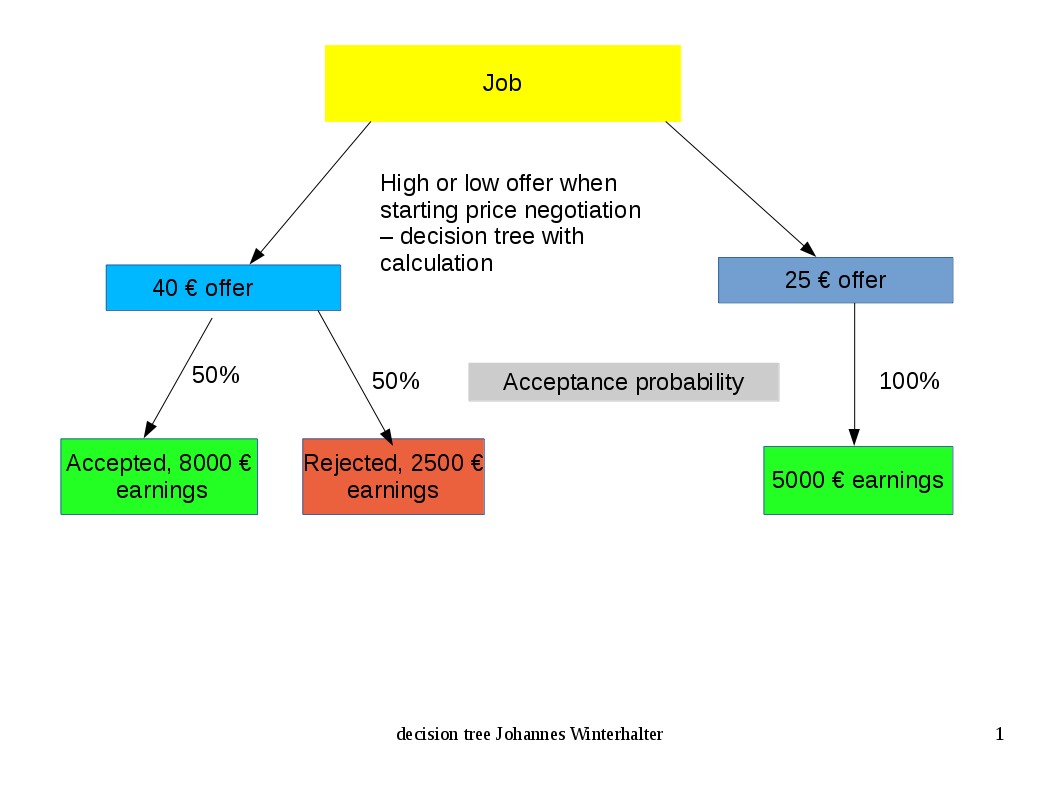
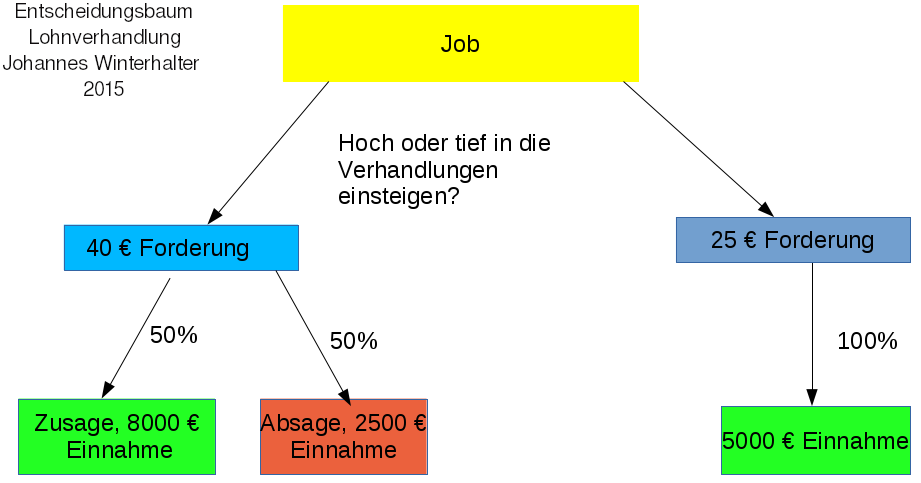
The probability that a sufficiently qualified applicant appears charging only charges 25 euros per hour is 50%. Let’s figure out whether Sandra should play it safe and demand 25 euros per hour or whether it is worth asking 40 euros per hour. The contract lasts for 200 hours, i.e. 5000 euros at 25 euros per hour and 8000 euros at 40 euros per hour.

Sandra realizes that she still doesn’t know enough about the lecturer market. What is the probability that in the case of a rejection by Dr. Teufel, a new job of the same type appears that brings in at least € 40 an hour? It is not possible to ask the competition, they will hardly tell the truth. Miss Dr. The devil is also talking about volunteering, so no wages at all.

Looking at the decision tree: if demanding 25 € per hour Sandra has the job safe and gets 5000 Euros. Demanding 40 € there is a 50% chance that she will earn 8000 Euro and 50% that she needs to go cleaning houses for 12,50 Euro each hour, that makes 2500 €. In addition and weighted by probability this goes to 5250 €, slightly more than talking about the low price.

External Factors – Prestige and Feeling Safe

Sandra possibly thinks she definitely needs the teaching job. She no longer wants to clean and needs references. Then she plays safe and only charges 25 € per hour. Demanding high prices is only worthwhile to a limited extent, as the previous analysis shows. The opportunity costs in the form of stressed nerves can be an argument for low claims.[3]
————————————————————–

  1. [2] To know this average value, information about the business model of the schools is necessary. The basis is the commercial calculation with cost price, handling costs – and profit surcharge and sales price. The lecturer’s fee is the cost price, the remuneration paid by the participants per lesson is the sales price. The trading surcharge includes rooms, advertising, administration and risk. [3]
  2. [3] Between 2008 to 2010 I did some tests with groups of 30 participants about that subject. The results were that very young people tend to ask too little money, older people tend to ask too much in price negotiations for work.

Increase Sales, Growth Hacking, Rainmaking, and Market Research

This article is a short introduction into the many names for the same processus: shoveling new clients into the sales funnel of the enterprise, increase sales and make everybody happy there – the customers with products or services they like and the seller with good earnings.

At the end of the article I add my recipe for lead generation. It works.

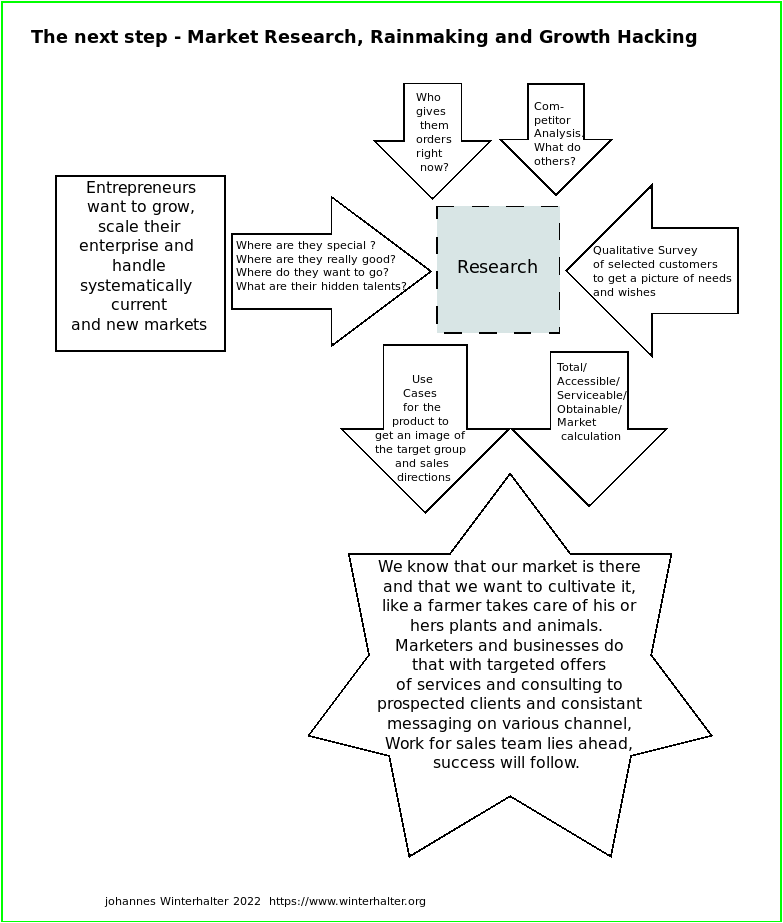
Rainmakers are salespeople who use techniques not directly visible to outsiders to acquire new customers. Rainmaking and market research go hand in hand.

Who looks for Growth Hackers and who for Rainmakers, and who needs Lead Generation?

Growth Hacking is made for start-ups.

They want exponential growth here. That could double weekly sales. Growth hacking also works for traditional companies that can expand their production fast enough and still grow their market. They only need to find a market.

Growth hackers are people who achieve such sales growth using methods that are not directly visible and easy to conceive for the environment. This gives their work something magical.

Rainmaking

Rainmakers are more traditional. They have an approach to sales not used in the enterprise beforehand, sometimes they also change the product line. This looks like magic to the employees in the enterprise. They may do own market research or user the services of professional market research analysts.

Extraordinary skills of the growth hacker

He sees unfulfilled human needs. She or he tests that in niche markets there it is possible to see how well a product is being received. Market research can test new products with well-known techniques, for example group discussion or sending out samples and questioning later.

According to Henry Ford, market research and customer suggestions were not the impetus for the development of the then revolutionary Model T, which was built in huge numbers. Customers would have wanted faster horses instead of cars they had never seen before. Growth Hackers and Market Researchers need to be visionaries to see the new product in his best shape.

Growth hacking is referral marketing

Inexpensive and fast customer acquisition cannot circumvent recommendation marketing. People recommend a product to others if it has helped them or arouses enthusiasm. Or if they can earn money with the recommendation.

Free trial access, distribution of samples, influencers, trial lessons, presence on social media – a lot helps a lot, like Germans like to say.

Outdated business models – leave it behind

People like to think that things who were once successful may be worth reviving or continuing. Market research finds if there is still a market for the product.

Rainmaking, Lead Generation and Market Research work together

Growth hacking is the product of many ideas and numbers. The firm belief in one’s own success is of no use if all market fundamentals oppose it. For example what to do if an analysis of the Totally Accessible Market shows only limited growth opportunities?

The market researcher also knows the penetration and effect of the individual recommendation or influencer channels and can doreliable tests.

Here the Working Recipe

Secret Recipe For Making Leads Rain                       
 ----------------------------------------------------------
 Who do I wish to be my client                             
 Why do I wish them do be my clients                       
 Who takes the decisions at my wished client               
 Who buys the stuff I try to sell already regularly        
 Who are my competitors                                    
 Who takes the decisions at the regular buyers             
 Where is it easier to sell                                
 Whats in for my buyers                                    
 Where can I reach my clients                              
 How do my clients like to be reached                      
 Additional arguments for my clients to buy                
 Expected costs to find a customer, in percentage of sales 

Why doing Market Research in Growth Hacking and Lead Generation?

It is about getting all the information about future clients to fine-tune the story to the product. The product might be a procedure for easing marketing or a tractor, which helps the owner and driver to do the job in the fields more comfortably, reliably and just better.

Fuel your story for account-based marketing, growth hacking and lead generation

Automated Product recommendations – Does Software Better Than Human Sales Staff?

The article deals with the possible uses of automated product recommendations in sales and customer service. There are buyers who prefer to buy on the internet for there they do not have to talk to human sales representatives. They probably had some experience with vendors staff hiding their cluelessness behind a lot of talk and are trying to sell their products on stockage at anyone who does not get away fast enough.

The problem looks hard to solve. But wait: for a few years now it is possible to extract valuable data points from primarely web activities and connect them with realised sales. The connector are either self-learning models or static traditional models. Models simulate behaviour and results.

The interested customer is looking für information before buying. He or she may ask a specialised salesperson and consultant who has all the relevant answers ready and can think in the customer’s interest. This relieves the customer. Or they, the potential clients, may look for publicly available information and customer review to avoid the advice of an inexperienced and overburdened sales representative.

Many sales representatives for complex products are quickly overwhelmed by the questions and expectations of well-informed prospects. The untrained salesperson feels attacked, the sales talk goes off the rails, the interested party prefers to buy from a supplier without advice.

The web part of customer journey

Depending on the product, between 80% and 90% of the buyers begin their customer journey with an search engine. So it is important for the seller to know what it is reported in the web, take care of the correctness of web information and avoid contradicting information. If there is human sales staff, they are supposed to assist the web customer journey and take care of a seamless process.

The consultant with all the facts in mind and the fully automatic customer advisor are extremes, the practical truth in the company lies in between.

Can the web be the better customer advisor?

Yes and no. The informations in the web and the informations given by a human sales person are supposed to go without contradiction. Nobody likes lies and deception.

Artificial intelligence makes use records of any communication with customers, for example chats, mail, data entries. This is compared with predetermined success goals. The model recommends something and can adjust itself. Something salespeople do intuitively, too, if the selling company lets them. Artificial intelligence therefore means less control for the management. On the other hand, opportunities are used that might otherwise have been overlooked. Where to start now?

Sellers are supposed to make as much information as possible available in a neatly structured way. Many people would like to find out more before making personal contact, but cannot find the information they are looking for. If publicly available documentations saves half an hour of calls per working day for the seller this justifies an expense of €2,000 for an improved sales website or other type of customer information – and that for telephone staff at a standard wage. Informed customers are better customers.

The meaning of human interaction

The ideal salesperson knows the buyers needs and wishes. He ors she build the best possible solution with his expertise. In between, looking up details and availability on the computer is essential for complex inquiries.

Advice form humans or from machines and websites?

Whether or not a human intermediary remains necessary for information collection and transmission depends on the product itself and on the personal preferences of the interested party. Some can evaluate and implement the freely available information, such as product descriptions, customer reviews and more for their own needs, while others cannot.

Good sales people relieve the customers. To do this, they must put the interests of the customer first and not fight for sales at any price. Consulting software in the sales pitch gives standardized information, if the software is capable of extracting the recommendation which work and then the client might be really happy.

Correct information with automated product recommendations
Correct product informations saves money for buyer and seller

Success has many reasons

Incidentally, the screen of the gentleman can turn directly to a prospective customer without the computer interfering. And if he needs information from the cloud or machine, he has it quickly at hand.

Village Storytelling And Advertising Today

The article is about storytelling in village communities still observed in the 21th century, conspiration theories and modern advertising. My experience as longtime villager and suburb dweller helped me.

I am living in the same village I spent my childhood some years ago. There are still many natives, some of them never moved out of their parents and grandparents house. They tell stories about families in the village, what they do, what the members of that families do and their fates.

Wondering why I did not know anybody mentioned in the stories while quite many villagers from associations, businesses and events, I asked the storytellers who these people are. The commone response was how could it happen that I do not know the people from the stories.

The characters are fictional. It is similar to movies many people have seen. Everybody is expected to know the story of the movie, and some words go into common language, like “catfishing” (pretending to be another person online), “gaslighting” (making somebody questioning their own reality) and “weinsteining” (behaviour close to what Harvey Weinstein is imprisoned for).

Village storytelling, repeatedly told by villagers, are the local kind of the bigger stories in movies. The stories connect the community. In the neighbouring village they have other stories the locals do not know.

Modern conspiration theories follow a similar scheme. Insiders know the story, and they feel the knowledge makes them much smarter or at least better informed than others.

What do we do with that information? There are stories others impose on us with the argument “As long you do not know the story you do not belong to us” or they use for gaslighting us. These stories are not worth anything for anybody except for the teller. There are other stories well told and worth remembering and retelling, for example “Good Wife”. Newly elected governments might also suffer the comparison between their results and the stories they told before election.