

Automated Product recommendations – Does Software Better Than Human Sales Staff?

The article deals with the possible uses of automated product recommendations in sales and customer service. There are buyers who prefer to buy on the internet for there they do not have to talk to human sales representatives. They probably had some experience with vendors staff hiding their cluelessness behind a lot of talk and are trying to sell their products on stockage at anyone who does not get away fast enough.

The problem looks hard to solve. But wait: for a few years now it is possible to extract valuable data points from primarely web activities and connect them with realised sales. The connector are either self-learning models or static traditional models. Models simulate behaviour and results.

The interested customer is looking für information before buying. He or she may ask a specialised salesperson and consultant who has all the relevant answers ready and can think in the customer’s interest. This relieves the customer. Or they, the potential clients, may look for publicly available information and customer review to avoid the advice of an inexperienced and overburdened sales representative.

Many sales representatives for complex products are quickly overwhelmed by the questions and expectations of well-informed prospects. The untrained salesperson feels attacked, the sales talk goes off the rails, the interested party prefers to buy from a supplier without advice.

The web part of customer journey

Depending on the product, between 80% and 90% of the buyers begin their customer journey with an search engine. So it is important for the seller to know what it is reported in the web, take care of the correctness of web information and avoid contradicting information. If there is human sales staff, they are supposed to assist the web customer journey and take care of a seamless process.

The consultant with all the facts in mind and the fully automatic customer advisor are extremes, the practical truth in the company lies in between.

Can the web be the better customer advisor?

Yes and no. The informations in the web and the informations given by a human sales person are supposed to go without contradiction. Nobody likes lies and deception.

Artificial intelligence makes use records of any communication with customers, for example chats, mail, data entries. This is compared with predetermined success goals. The model recommends something and can adjust itself. Something salespeople do intuitively, too, if the selling company lets them. Artificial intelligence therefore means less control for the management. On the other hand, opportunities are used that might otherwise have been overlooked. Where to start now?

Sellers are supposed to make as much information as possible available in a neatly structured way. Many people would like to find out more before making personal contact, but cannot find the information they are looking for. If publicly available documentations saves half an hour of calls per working day for the seller this justifies an expense of €2,000 for an improved sales website or other type of customer information – and that for telephone staff at a standard wage. Informed customers are better customers.

The meaning of human interaction

The ideal salesperson knows the buyers needs and wishes. He ors she build the best possible solution with his expertise. In between, looking up details and availability on the computer is essential for complex inquiries.

Advice from humans or machines and websites?

Whether or not a human intermediary remains necessary for information collection and transmission depends on the product itself and on the personal preferences of the interested party. Some can evaluate and implement the freely available information, such as product descriptions, customer reviews and more for their own needs, while others cannot.

Good sales people relieve the customers. To do this, they must put the interests of the customer first and not fight for sales at any price. Consulting software in the sales pitch gives standardized information, if the software is capable of extracting the recommendation which work and then the client might be really happy.

Correct information with automated product recommendations
Correct product informations saves money for buyer and seller

Success has many reasons

Incidentally, the screen of the gentleman can turn directly to a prospective customer without the computer interfering. And if he needs information from the cloud or machine, he has it quickly at hand.

Village Storytelling And Advertising Today

The article is about storytelling in village communities still observed in the 21th century, conspiration theories and modern advertising. My experience as longtime villager and suburb dweller helped me.

I am living in the same village I spent my childhood some years ago. There are still many natives, some of them never moved out of their parents and grandparents house. They tell stories about families in the village, what they do, what the members of that families do and their fates.

Wondering why I did not know anybody mentioned in the stories while quite many villagers from associations, businesses and events, I asked the storytellers who these people are. The commone response was how could it happen that I do not know the people from the stories.

The characters are fictional. It is similar to movies many people have seen. Everybody is expected to know the story of the movie, and some words go into common language, like “catfishing” (pretending to be another person online), “gaslighting” (making somebody questioning their own reality) and “weinsteining” (behaviour close to what Harvey Weinstein is imprisoned for).

Village storytelling, repeatedly told by villagers, are the local kind of the bigger stories in movies. The stories connect the community. In the neighbouring village they have other stories the locals do not know.

Modern conspiration theories follow a similar scheme. Insiders know the story, and they feel the knowledge makes them much smarter or at least better informed than others.

What do we do with that information? There are stories others impose on us with the argument “As long you do not know the story you do not belong to us” or they use for gaslighting us. These stories are not worth anything for anybody except for the teller. There are other stories well told and worth remembering and retelling, for example “Good Wife”. Newly elected governments might also suffer the comparison between their results and the stories they told before election.

Using A Group For Improving Advice

This post is about using group decisions for personal development and avoiding the trap of getting contradictory advice. A scaled down method from social research is useful to get better advice for personal and business matters.

“Guter Rat ist teuer” (Good advice is expensive) is an old German meme. Jokes transfered that to “Guter Rad ist teuer”, meaning a good bicycle is expensive. This is also true for getting good advice in transition periods, where many of us are vulnerable and insecure.

Some annoying people give unwanted advice. Their motivation is to lift themselves and their self-esteem by influencing somebody to change behaviour. Social and market researchers exclude some participiants for the reason that their opinion is not helpful. For personal and business growth it is important to ignore them too.

We like to ask people we know and we trust. They tell us their opinion looking from their own situation. For giving best advice they are supposed to leave their world and go into the thought system of the one they want to help. That is not easy to do and it is prone to errors. Example: I (the author) am really good at fixing cars and bikes. I am inclined to I think everbody can do that. For many people that skill is not important, so they cant, and I have to consider that if giving advice.

So, what to do, to not fall into despair after the first advice from a friend, collegue or coworker or fall into more despair after getting different advice and statements from different people.

How about asking for example 20 people, and write down or memorize the answers. If the same answer appears more often, there must be some reason behind it. I do not include the statistical proof for that right now.

For me that technique solved a personal problem: I generally do not trust human authorities. I think most of them are somehow crazy, corrupt and stupid. How to find truthful information with this precondition? I want to participate at the wisdom of humanity. My solution is finding opinions and statements which are similar – if many rely in the same facts, there must be some truth in it.

Another way for solving similar problems you might find here: Price Negotiations and Decision Tree. There you make a decision tree and add probabilities to each event.

Targeting Marketing With Qualitative Market Research

Why we need a buyers persona

A buyers persona is a picture of our targeted group. It says persona for the reason we do not need to know everything about that person and there might be different persons in our target group. The second part is about qualitative market research. We use this kind of searching for behavioural characteristics for creating this buyers persona.

A wrong image of our target group costs us money and makes our brand less popular. Simple example is posting on Linkedin without reducing the number of followers. I looked at the list of people I unfollowed. The reason for doing that was that they posted repeatedly content I do not like or is just not true. Most of them are aging german business trainers spreading far-right political statements and sometimes even far-right lies. The other ones are sales newbies who spread too often their pitches aimed at a different buyer persona than me. Is a close group of followers who believe the same political statements as the poster the thing the poster wanted? If there is no reaction to your post does hammering out repeatedly the same sales pitches again and again to the wrong targets a good thing? Or should we appeal to a broader audience?

Why qualitative Market Research

This article is about bringing qualitive and quantitave research together with integrating numbers and representativity into qualitative research. Quantitative research is primarely counting and statistics.

To research people ‘qualitatively’ means that you intend to understand them. This is beyond algorithms. Let me show you how best to do this. I am here to listen to you. (Elif Kus Saillard)

The topic of qualitative market research is understanding. What does the world of my target group look like? What emotional and financial settings do they have? Quantitative research, on the other hand, determines how many people in the target group have which attitudes, how many they are and how their budget looks. A random sample is drawn so that not all members have to be questioned.

The claim of qualitative market research

Qualitative market researchers understand the customers. Its like some newspapers articles, where journalists describe some individuals where they think they are good for the numbers. Quantitave shows the numbers – for example 60% believe that the government does a good job in education. Discussions in focus groups, in-depth interviews, images, social media and much more can be used as data sources for qualitative research.

Correct information with automated product recommendations
What will be the result of qualitative market research into her wishes?

Also compare here (New Market Research Blog). The qualitative market researcher is an active part of the research process. He or she uses their subjectivity to better understand the phenomenon being studied. You want to understand why people believe in what and see the world a certain way. A qualitative researcher wants to understand the process of selecting a product, for example. A quantitative researcher wants numbers, averages, and more. Manufacturers and dealers can then base their decisions on this.

How qualitative researchers can do representative studies with small numbers

A qualitative researcher makes small samples. Understanding the process and the mindset of the subjects, this researcher assumes some validity. To ensure this this procedure can help:

The result of the small sample are suitable when no changes are to be expected from a larger sample. This can be checked by first evaluating 30 questionnaires. Hopefully there is no significant change with a further 10 questionnaires. If there is, another 10 questionnaires are added. If this does not maintain the hypothesis that the differences in responses are statistically insignificant, the study can be considered representative provided the responding participants represent the target group.

Some subjects suitable for qualitative studies:

  1. Lists of ideas – if the ideas are repeated, the study can be ended. Studies that do not record the subjects’ ideas via structured questions but via free text information fall into this category.
  2. All – or – none results. If every participant in a small study says the same thing—like, “I see a train station in this ad,” or “I prefer the new packaging”—the conclusions are likely to be valid, even with small samples.
  3. Strong hypotheses for the study to support If we have a hunch and it is supported by the small sample, we can be sure that the hunch is correct. All we have to do is verify that the underlying hypothesis is not just speculation. This type of market research is popular with journalists who can get by with just a few interviews.
  4. Understanding instead of measuring – for example customer journey. This analysis helps testing new products.

The problem of representativeness in qualitative research remains.

With small samples, the problem of representativeness remains. There is no statistical way to ensure the representativeness of a non-probable sample. The market researcher’s judgment must be added here: can the result be as the study suggests or are there other, contradictory results? Trusting only statistically proven results without knowing the underlying connections can be misleading.

How prices are perceived from seller and buyer

Pricing affects everybody. Selling your apartment, selling used furniture, doing salary negotiations or finding prices for your products. How to find a price liked by the seller and buyer? In my seller history I found situations with low prices where the customer voluntarely added a gift, and many situations where nobody wanted to buy. The reason for this can be “no market for the product” and “price is prohibitively high”. The latter one means there is a market for the product, but not at the charged price.

The next chapters give structure to this complicated matter.

The classical theory of pricing for optimal is very simplified. It assumes a linear demand function, with only one determinant, the price: demand=f(price) . This means only demand determines the price. What happens if demand has many more determinants?

This can be:

  1. The look of the selling (web-)site
  2. Do the salesmen make a good job?
  3. Do I get good advice from the staff?
  4. Can I expect some value if I pay more?
  5. Does the product make me feel better?
  6. Do I have the budget for luxury?
  7. What are the prices of the competitors?
  8. The price the seller wants

Point 1-4 are the value to the product added by a good sales team. Example: if a retail store buys a pallet with 1000 packets pasta for 600 € and sells the package for 1,2 € the sold package is not the same product as on the pallet. The services of the retail store are added.

The following graph is an example. It may look different for a specific produkt. The graph with the numbers given there works good for used cars and expensive utilities sold on Ebay or webshops. Later in this posting I discuss the concept of a buyers persona for looking at different perceptions and factors which influence willingnes to pay.

What Expectations and Experiences determine the market price of a good
What Expectations and Experiences determine the market price of a good – example with estimated numbers for factors influencing the market price in the case of price differentiation (customers pay different prices).

Example: make advice a valuable good

Many brick-and-mortar retailers complain that their customers do not pay for advice. What they do not tell: how much do their prices differ from common internet sellers without any consultancy? Is there really value added in the store?

In old times, when sales was based on printed catalogs, there was the famous trade costing, with list prices, heavy rebates, and purchase prices. Most retailers ordered their stuff at wholesales, which themselves made their cuts. The result was that end user prices were about 3-10 times as high as the factory price. I understand that many want this time back. The customers had no choice, they had to buy locally. Many wishes and dreams of customers weren’t ever fulfilled for the high costs of maintaining catalogs and storage.

Now many internet retailers order directly at the manufacturers, and they have to look for competing offers worldwide.

Customer or Buyer Persona and Pricing

Customers view the product and selling environment different regarding their personal lifestyle, income and values. Depending on the product I normally look at two up to four buyers personas with different characteristics, where I draw a line between them with the help of characteristics I found with market research.

Selling Services

There are two approaches for long-term pricing: with interchangeable goods, many manufacturers, in the long run the price will be the production cost plus some earnings. The earnings are the incentive for producing. Examble: a spare part for an historic car. Production cost is 150 €, with this part added the car gains 2000 € value. If the seller knows that and wants a high price, the buyer might look for another source which produces it for 150 € and pays additional 50 € for the favor.

In Services it is a bit different. Production costs is one side. The other is: how much will the buyer profit from my service? If the seller, you, knows that 25-50% of the profit for the seller, the trainer or consultant, are normal.

Is there a formula for prices?

In economic theory the price is equal to marginal use. That means the price equals the benefit the buyer thinks he has from the last unit he or she buys.

If we can measure the benefit in money and realtime, we have the formula.

The benefits are listed at the beginning of the article. The problem is that the customer does so many estimations, that change over time. Also new competitors with low price entrance strategy might show up.

When selling over a website it is quite easy. Look at the ones who buy related to the ones who look at the article. If there are many who look and do not buy then lower the price, if most of the visitors buy then raise. This needs a lot of finetuning. Sometimes visitors look a few times at the articles until they finally buy. When they see that the prices go down, they might wait even longer. So you might want to include the total number of visitors.

How to calculate?

There is a mathematical formula and there are ways to survey it.

We measure the first eight determinants, with due consideration of costs:

determinanthow to find and count
The look of the sales (website) position.Survey of visitors
Are the salespeople doing a good job?not available everywhere, get feedback
Do I get good advice from the staff?Get feedback
Can I expect value if I pay more?Tests and surveys on buying motivation, own samples
Do I feel better because of the product?Tests and surveys on buying motivation
Do I have the budget for luxury?Experiments, interviews
What are the prices of the competitors?Research
The price the seller wantsLook deep inside you

Market research helps with the first six points. Usually it is necessary to repeat the market research every 3-6 months with the well-known market research problem: the target person doesn’t like to answer. They are bored and do not know whatfor they took their time to answer the questions. We must therefore look for other methods. An easy-to-install method is to encourage visitors to comment. You may get 1-5% comments from the customers. This responses add up to valuable data source. It is also possible to conduct studies with paid testers. There are some problems with representation of the correct user group there, additional research helps to circumvent this.

Photo du titre by Egor Myznik on Unsplash

Predict the number of future clients – howto

Total addressable market analysis – what does it mean for your plans

To predict the number of future customers we use Total Addressable and Acessible Market analysis, TAM. The technical term TAM refers to the number of possible customers and the number of products that they will buy as a whole. This is the full market. If you sell cars, everyone can be your customer. There are competitors, and not everyone is going to buy cars from a new producer. So the number of cars you are going to sell is smaller like the market for automobiles. If you want to sell Yoga classes, everyone is a potential customer as well. The vast majority of clients for Yoga classes are women, which decreases the number of clients. People who need to go over 30 kilometers for the workout are unlikely to buy your lessons. For a year now, Covid-19 has been a big problem – either lessons together in a gym are prohibited, or older clients do not want to come due to fear of infection.

The total addressable market narrows down to the servicable accessible market.

These are the customers who may be ever hear from you and suscept you as your potential supplier. You have to be able to sell your products to them. This is much closer to the reality and is one step calculating your future sales.

The third and most important technical term is the “_S_ervicable _O_btainable _M_Market”, SOM. These are the real customers, the ones you can serve and the ones who want to buy your products. They need to know your products and services.

The math

For calculationg, demographic statistics are important. These data indicate the number of people in the target region.

How to find the number of potential customers? The primary source is Wikipedia (really) and the governmental Statistics Office. Their data is normally free. The state administration places great value on correct data. They use this to distribute taxpayer money.

You can find more than population data there. The number of dairy cows is also there, and a lot of the data by economy. So it is possible to predict the number of future clients.

Boutique market researchers sell premanufactured reports

Using google to search for the data you arrive at several websites that are trying to sell industry reports. The normal price for these reports is between 800 and 3700 Euros. On my Fiverr account, a website that acts as an intermediary between freelancers, a lot of requests are aimed at selling these reports for less, say 80 €. The reason the prices are so high is that the authors use the most expensive data, for example at Bloomberg.

Is it necessary to pay more? For small entrepreneurs who offer specialized products, the answer is no. The reason is: it doesn’t say anything which we can use to predict the number of future customers.

Data Quality needed to predict the number of future clients

To estimate the SOM, industry associations offer a lot of data. Perhaps this data is old, but there are no or little fees.

The internet offeres a lot ot data about what is popular with users and what they think an want. That data is hard to find and to be familiar with with web evaluation and web scraping ist helpful. In 2020 I worked on a market study for flower pots. There was a lot of data coming from the associations of the friends of the gardens. They show me that all people love their garden and their flowers more and more. Are the data true and dear to the seller of the flower pots? How much money do they want to spend on the jars? What appearance will they like? Lots of work to do.

Quick and only a little dirty

For very quick results it is possible to do an analysis of reviews on Amazon and other sellers. There is software to do this. Youtube is full of videos that show you this technique. Here are some basics how to analyze that (German) and how I do it.

Why we use Bitcoin for creating wealth, not for daily payments

Bitcoin is a freely tradable cryptocurrency. A currency needs security against unauthorized copying. With normal money this is done by the central bank and the state, with bitcoins with strong encryption and a publicly accessible database with 262 gigabytes of data in May 2020.

There is a maximum of 21 million Bitcoin to be scraped. Currently there are 18.4 million. A limited amount of a good gives hope for an increase in value. That is the matter with gold, in some areas with housing. The prospect of increased value makes people to invest in goods who bear no interest. In the following, I analyze whether buying and selling Bitcoin might bring a good return.

Bitcoin lures with impressive price fluctuations, longer periods of steadily rising prices and, unfortunately, a few crashes.
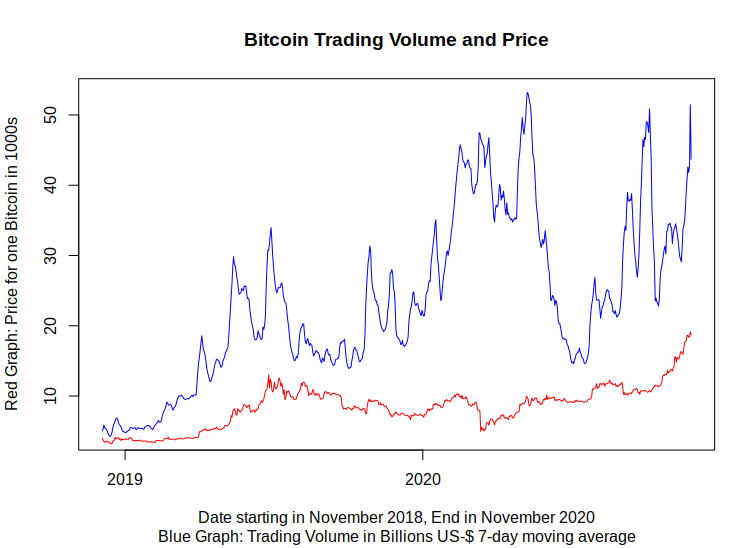
The lowest price for a complete Bitcoin in the period covered by the graph was 3207 US-$ on 2018-12-14. Successful traders bought for example for that price and sold high for 19107,46 US-$ on 2020-11-24. Which good makes six times its value in two years?

In the years after I wrote this article the bitcoin reached 40.000 US-$-

I used the close prices of the days. Bitcoin prices are changing fast along the day. About 15% of all existing bitcoins are sold on one day. Also high prices slower the market: it is visible and statistcally noticeable that high prices lower the trading volume. That is not only in cryptocurrency market. Real Estate also knows this phenomena.
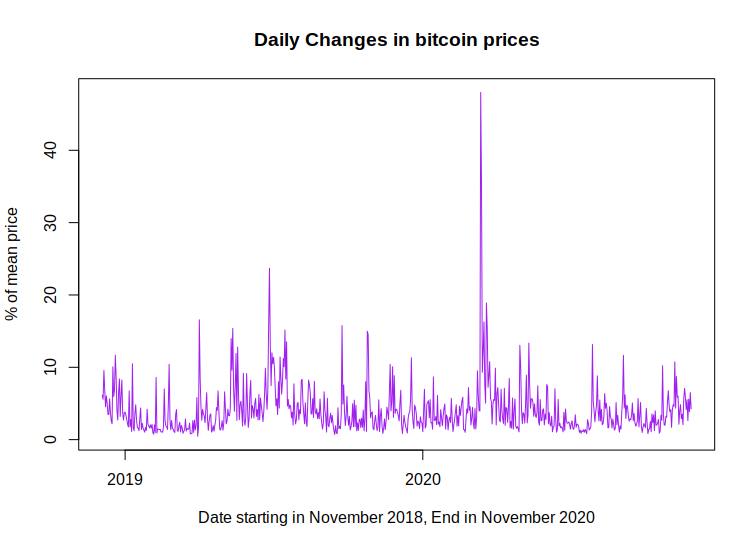
The picture shows that during the normal day the prices fluctuate by 5-10%. Only on explosive days, less than 11 days out of 723, did prices fluctuate more than 15%. Considering usual transaction fees of 0.1-5%, you can win and lose very quickly. Current sales offers and trading conditions can be found e.g. here.

Bitcoins are very speculative. The reason for the many offers for investing in Bitcoin is that if somebody owns already the currency convincing others to buy it also raises the prices. Now it is possible to sell the the own stock and make a little fortune.

Using Bitcoin for payments

Bitcoin als Zahlungsmittel
Bitcoin for payments

for legal transactions:

The fees for exchanging cryptocurrency into stone age currency such as Euros or US dollars are 3-5% of the value, as is the case for transferring an amount of money to another account. The reason is the high computing power required for the encrypted currency. PayPal takes 1-2.5% of the transferred amount for the same service, the banks go down to 0.1%. The advantage of Bitcoin is the secure transmission: are the bitcoins stored in your wallet they are yours. There is no chance for the delvering side to get it back, like for example in European direct debit authorizations.

Bitcoin for the darker side of business
Are Crooks dishonest

For transferring unlawful earned money the cryptocurrency is well suited. The account owner can remain anonymous; no connection can be established between the account holder and a natural person. The Bitcoin accounts are publicly visible, so the threatened person can, for example, see how much the account holder has already harvested with his criminal actions in the case of extortionate emails.

How do I change the price?

The price elasticity of the demand for Bitcoin is positive overall. That means rising prices increase demand and vice versa. It therefore makes sense to find as many co-investors as possible. These buy with you, and your bitcoins go up a bit in price. You just have to get out before the co-investors want to sell. The price may drop and eat up your gains.
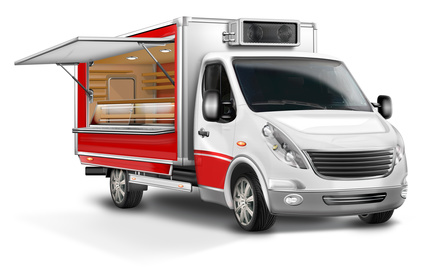
Food Truck – how to use it for making money

Business location for starters – the Problem  We think there is  a lot of money to be made with a mobile snack stand, a food truck and other sales vehicles. Additionally it is not only making money: it is fun to  prepare and selling food and drinks.

For example, independent sausage sellers in their food trucks and carriages on the Freiburg Münsterplatz are estimated to have a six-figure annual income per car. These people endure the market in cold and hot weather and most of them do not have to publish balance sheets. There are therefore no generally available figures on the income from sausage sales, it must be estimated.

The following article contains a model calculation to determine the expected profit with a food truck or trailer. Advertising and the very important factor “sales per customer” are taken into account.

If the dream of your own food truck or trailer is to become a reality, you need a wagon and one or more selling places. When researching a truck, I will quickly come across offers from franchisors. At first glance, at least to me, these look new and inspire me very soon. After the first impression, I just want the car.

The smart entrepreneur thinkss: “First check the calculation”. The sample calculations submitted by franchisors could be daring and presented very nicely. The realistic scenario is possibly hidden between airier calculations. Speculatively high assumptions about workloads create unrealistic high earnings.

A serious seller does not lie, he arranges the facts nicely. A simple trick to make things beautiful but not wrong bases on the fact that people love the middle. We intuitively think the middle scenario is realistic, the left one is bad and the right one is so good, that it will not happen. And already we are in the mental trap. The scenario in the middle is in reality the extreme upwards. The very good case shown in the “good” column of the sample calculation, usually on the left, cannot be achieved.

The formula for the financial success of mobile sales stands and food truck

Here is a formula that is simple and works well. Some market research is necessary for some of the necessary information, I just give estimated figures.

Lets start with the sales volume.

The turnover U is calculated from the number of passers-by n, the purchase probability for each passer-by p (p) and the turnover per buyer u (p). So daily turnover = n * p (p) * u (p). We see 500 passers-by every day. Of those, 10% buy. Everyone makes a turnover of 5 €. This results in a daily turnover of 500 * 0.1 * 5 = 250 €. That is not much, as we shall see later.

The costs add like that:

Daily costs = stand rental + purchase price of the car / service life in days + maintenance costs + energy costs + labor costs + cost of goods + advertising other ancillary costs.

Fixed costs: stand rental, depreciation, wage costs (fixed jump)
Variable costs: maintenance, energy, labor costs, goods

Example:

A food truck or trailing carriage with the same purpose has space rent of € 30 per day, depreciation is € 25 per day, energy costs € 10, maintenance € 5, our minimum wage worker costs € 100 per day including social security contributions and vacation. We make € 250 in sales every day, the cost of goods is 40% of sales. Taken together, this results in a daily loss of € 20. What to do? The employee complains about stress and how much he has to do.

We check what the employee is actually doing. He needs three minutes per customer and has 480 minutes a day, of which he needs 45 minutes for preparation and cleaning. That equates to 435 minutes for the customer – with three minutes per customer that’s 145 customers a day. Nobody can serve customers quickly and permanently for 8 hours at a time. There are also times of weak demand. We therefore assume a maximum utilization of 50%. That would be 72 customers every day. So far we have had 50 customers a day. So the employee could do a little more.

We decide to do a promotion. This costs 30 € daily and brings 20 customers daily. The turnover increases to 350 € per day. Previous costs + advertising + more cost of goods = new costs.

270 € + 30 € + 40 € = 340 € costs, 350 € income, we finally earn a little. But not enough to cover our entrepreneurial risk. We want 15% of sales, € 10 per day is just over 3%.

We achieve the 15% minimum profit with a slight increase in customer sales to € 5.5. With 70 customers, this equates to a daily turnover of € 385, the costs then amount to € 324 per day.

The number of customers matter

Mobile food trucks and trailers are a a business of big numbers. Additionally it has some similarties to real estate business: location is everything. In addition, a clever price and product policy. This increases sales per customer. He is offered what he wants and his wishes are addressed. Franchise concepts must be checked to see whether they allow an increase in customer sales. In addition, the sales time per customer must be low. The sausage barons can serve a customer in less than a minute and generate € 2.20 in sales.

More revenue per customer

Here, high sales per customer combined with mass business lead to the desired profit. The sales car must offer enough space for this.

Sidelining with a food truck

They are easy to operate part-time. Because of the lower capacity utilization, the depreciation per working day is higher. In addition, a parking space is required for the idle time. For this we can choose days and places with high turnover at public festivals and in summer. The good places are hard to come by at first. With patience and a start-up time, they will also become accessible in the long term.

If you think help helps you:

I have another article about finding a good place for the carriage /food truck.

finding a place professionally (German)

Food Truck on a Motorbike

Product tests, research and lean user

Many new developments or enforce one product over an extended time?

Fast innovation cycles produce a lot of new products and ideas. Most of them do not meet any user needs and fail, others are successful. Normally every freelancer or businessman develops some products and sells it. The products change over the years. For myself, the first product I sold was myself as teacher, later as a sales representative, computer specialist, coach and so on.

German business coaches tell: limit yourself to one product and sell that, be the best seller in that market. From the US I hear: develop a lot of products. Some get greater acceptance. There is your chance to have success. Lean User Research does not mean the user has to have a slim body. It means that the process of researching is lean.

How to get through that?

Concierge MVP in market research

There is an approach called Lean User Research. It is qualitative market research, with elder technologies arranged in a new way. One technique is known as Concierge MVP where MVP is minimum viable product. These means testing a product which is not yet finished or even not exists. How to test that? Do the process manually, change the process slightly and do more testing. When finished the entrepreneur knows what the user needs and can start building the software or the machine. Setting up an assembly line is expensive. Because of this intensive testing before is approbriate.

Adaption-Level-Theory and Lean User Research
The Adaption-Level-Theory. Lean User Research helps to find the level of acceptance

Fake Doors Test

This is done by announcing products which do not really exist. Measuring the interest on that products gives information. This helps to decide about further development. This kind of tests has disadvantages. Some products need some time until they get into the users mind. And announcing too much ghost products will give a bad reputation. If you want to try that: first read about marketing a person. If you are from middle Europe you know: The first impression about a character stays forever. People do not accept any changes, it does not fit in their picture of the world.

How probability calculations assist making sucessful price negotiations

Wage bargaining and price negotiations

There is a slightly different German version of this article here.

Bargaining and trading about wages and prices for personal services is not easy. It may be the price tag for your own work, for yourself. On the other side high wages killed a lot of enterprises or forced them to shrink. Low wages combined with high productivity mean advantages in a competitive market.
An employer will hire a worker if the net worth of his work bigger than the his wage. Low wages and high productivity means more yield for the employer, more bonus and next career level. The employee or the seller of services wants to make more money. They know that overpay means being to expensive and getting laid off first.
What to do in this situation? Let me explain two different approaches:

Using Market Research, Game Theory and Scenarios

Let me give an example for a freelance teacher who bargains with a school. This private vocational school, Schulungs-Center Montgomery, does not pay equally. Most of the teachers are freelancers. Their price is 20 to 45 € per teaching hour. The teaching hour is 45 minutes. The teachers are forced by contract to keep their wages as a secret.
Sandra needs money and wants to teach Her Master of Business Administration is freshly examined.
She tries to get most of the situation. She looks at the website of the Schulungs-Center and notices the student’s tuition. 420 Euro per month. She thinks: 5000 € per year, 12 students in a class, 1000 teaching hours per year. That makes 60 € per teaching hour. 50% for general purposes and 50% for the teacher – that would be 30 EUR per hour for the teacher. For a new employee it is difficult to calculate how much money the employer will earn. Some market research helps.
May be, because of female, young professional the Schulungscenter will pay more? When looking at the staff she sees a lot of elder, retired people who will work for less than 25 Euro per hour.
She has two alternatives: either starting with 40 Euros per hour, with the risk that being young and well-educated is not sufficient to get more money, or going to the safe side with 25 € per hour. .

decision tree usable for price negotiation and bargaining - probability and earnings
decision tree usable for price negotiation – probabiliy and earnings

The Calculations

Say, the teaching duty is about 200 hours. If Sandra does not get the job, she has to clean rooms for 10 €/hour. We assume the probability to get the job is 50% when offering her teaching services for 40 € per hour, and 100% when offering for 25 € per hour, like in the chart. So she will get 5000 € when demanding 25€ per hour and (40 €/hour*200 hours * 50%)+ (10 €/hour * 200 hours *50%)= 5000 € when demanding 40 € per hour.

In this model, which is very close to reality, it does not matter if the teacher demands 25 € or 40 € per hour. The earnings for him are the same.

So what to do? Sandra should look at the whole picture of the economy to decide if the price for teaching rises or falls. In Freiburg where was a decline in the demand for freelance teachers in the last years. Classes shrunk, fewer students, less money.

Self-Esteem and better prices

Roman Kmenta has a very simple theory: High self-esteem, high income. Following his writings, Sandra should demand 40 € per hour and not falter. With high prices she tells everybody that her services are valuable. This will impress her contractors and they will accept her offers.